
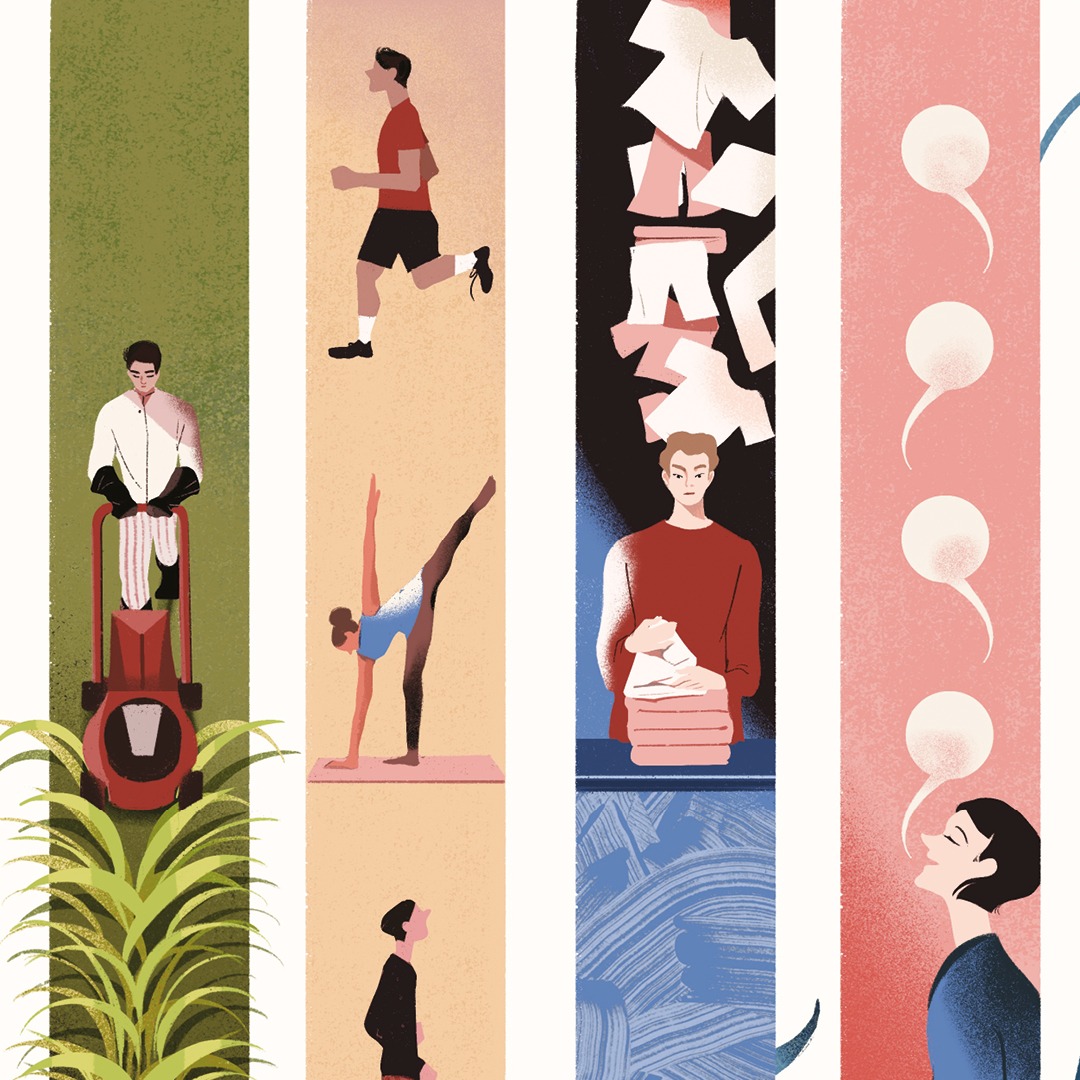

Knit one, purl one. Knit one, purl one. My fingers fall into rhythm with the constant click, click, click of knitting needles. Somewhere in the repetition of stitch and pull, left to right, back and forth, something in me settles. The predictability, the rhythm, the challenge without it being too demanding. My shoulders loosen and the mental chatter quiets. Repetition, it turns out, is its own kind of peace.
Your version of repetition may not involve yarn or needles. The task could be as simple as weeding a garden, braiding hair or chopping vegetables. Some experts believe that repetitive tasks can help foster a connection between body and mind, while guiding you away from negative thinking patterns. The key, though, is intention.
Headspace vs bodyspace
When it feels like your brain has too many tabs open or is overwhelmed with thoughts, engaging in physical repetitive tasks could be beneficial. This focused attention helps you transition out of your headspace and into your bodyspace; in other words, from living in your thoughts to being grounded in your physical sensations and body.
‘Many people spend much of their day in what I would call headspace; thinking, planning, worrying, analysing, replaying conversations or anticipating future problems,’ says American psychologist Nicole Anders, who specialises in treating trauma and in women’s health. ‘While the ability to think and reflect is valuable, staying in that mode continuously can contribute to stress, anxiety and a sense of disconnection from your physical experience.’ According to Nicole, repetition of physical tasks creates an opportunity to direct your attention away from unhelpful mental chatter and towards physical sensory experience.
In addition, the familiarity and predictability of repetition can be calming. This could be through watering a garden or grooming a pet with long, repetitive brushstrokes. ‘When movement becomes rhythmic, predictable and non-threatening, the body often shifts away from a heightened state of vigilance and towards greater parasympathetic activation, sometimes referred to as the rest and digest response,’ explains Nicole.
‘This can lead to measurable changes such as a slower heart rate, more regulated breathing patterns, reduced muscle tension and improved heart rate variability, which is often considered a marker of nervous system flexibility and resilience,’ says Nicole. ‘Repetitive movement provides consistent sensory feedback that signals safety to the body. Over time, this can help reduce stress hormone production and support emotional regulation.’
Gentle focus
While it might be tempting to zone out during repetitive tasks, the real benefit comes from maintaining gentle focus. Without this, the mind drifts, which can activate the default mode network (DMN). This is a collection of brain regions that tends to become more active when the mind is wandering, called monkey mind by some psychologists, that jumps constantly from one idea or impulse to the next. Excessive DMN activity is often associated with repetitive worrying, overthinking and mental rumination.
Repetitive physical activities, when approached with gentle focus, can quiet this activity, giving the DMN a rest by anchoring attention to the body and the rhythm of the task. The result is not an empty mind, though.
‘This does not mean the mind becomes completely blank,’ says Nicole. ‘Rather, there is often less mental noise and greater engagement with what is happening right now. Many people describe this state as feeling calmer, clearer or more mentally spacious. Activities such as yoga, rhythmic walking, running, gardening or repetitive household tasks can facilitate this shift by naturally combining movement with sustained attention.’
Picking an activity that requires a small level of challenge is a way to encourage sustained attention and avoid your mind drifting. Examples could be colouring in, polishing silverware or addressing envelopes by hand.
According to American neuroscientist and founder of Umo Health Scott Mongold, the impact of an unfocused mind runs deeper than just distraction. ‘A really interesting study that tracked thousands of people through their days found that minds wander nearly 47 per cent of waking hours, and that mind-wandering, and other time spent with DMN turned on, reliably predicts unhappiness,’ says Scott, referencing a 2010 Harvard study titled A Wandering Mind Is an Unhappy Mind. ‘The analysis suggested that the wandering was generally the cause of the low mood,’ Scott explains. ‘So turning off the DMN by focusing on simple physical tasks could be useful in reducing introspection. This may be one of the mechanisms behind mindfulness practices showing benefits for anxiety, depression and pain: they may work in part by reducing DMN activity.’
Embracing repetition
Repetition is often seen as a shortcut to boredom, but when used correctly it can be a gift. Next time you’re doing a repetitive task, perhaps stirring a cooking sauce or folding laundry, engage with it mindfully and intentionally. Don’t see it as something to tick off your to-do list, but as an opportunity to experience the world around you rather than needing to analyse or optimise it.
Scott suggests, ‘Pick one or two of your senses and deliberately track them. Notice the temperature and texture of what you’re touching, the weight in your hands or feet, the sound of the movement or the visual scene in front of you. Breath is probably one of the most common and easiest sensations to track. You can focus on the sound it’s making, the movement of the chest or the sensation of air entering or exiting the nose or mouth.’
For those who regularly engage with mindfulness or other tasks that regulate the DMN, the shift could be almost immediate. For others, this muscle could take longer to train and to adjust. ‘I often compare it to entering a swimming pool,’ says Nicole. ‘The first few moments can feel uncomfortable because the mind is still carrying momentum from whatever happened before. As the activity continues and attention repeatedly returns to movement, breath and sensory experience, the nervous system gradually settles.’
Give yourself time, and don’t feel pressure if you don’t experience the benefits straight away. ‘Most people will need to allow themselves at least 10 to 20 minutes of uninterrupted engagement before experiencing significant mental quieting,’ says Nicole. ‘The key is consistency rather than forcing relaxation. The shift often emerges naturally when you stop trying so hard to make it happen.’
Moving meditation
Intentionally focusing and engaging with repetitive tasks can also be a gentle alternative to traditional seated meditation. ‘I often tell clients that mindfulness does not require a meditation cushion,’ says Nicole. ‘What matters is not the activity itself, but the quality of attention we bring to it. For many individuals, repetitive movement becomes the doorway through which a deeper mindfulness practice eventually develops.’
For some, this moving meditation could come from the repetition of crafting, or flow yoga. For Australian former chef Jarman Gosai, it came from chopping vegetables when he worked in commercial kitchens. ‘For those prep hours… my mind would clear, and I’d find myself reflecting on things I usually didn’t have the headspace for: where I wanted my life to go, what was actually bothering me, what mattered,’ says Jarman. ‘Long after I stopped working in kitchens, I realised the chopping had probably done more for my mental health than any of the formal meditation I’d half-heartedly attempted before or since.’
Jarman has now hung up his chef’s apron, but he actively seeks out the same sense of calm in repetitive tasks. ‘These days I don’t find myself in the kitchen for hours at a time, which I’m thankful for, but I do find brief moments of zen, like the kitchen days, where I’m folding washing or mowing the lawn.’
When it is approached intentionally, therefore, physical repetition can be a quiet but powerful tool to calm a restless mind, as well as being a gentle bridge into mindfulness or meditative practice. ‘Repetitive tasks offer a more accessible pathway because they provide both movement and structure,’ says Nicole. ‘The body remains engaged while attention gently settles into the present moment. This can create a sense of safety and stability that makes mindfulness feel less intimidating and more achievable.’
Activities that give the gift of repetition
Before you begin a repetitive activity, pause. Take a moment to notice how you feel, your mood, your breath pattern and any tension in your body. Do the same when you finish your task. Notice and acknowledge any differences before and after the activity.
Gardening
Weeding, deadheading flowers or pruning are absorbing, satisfying activities that anchor you to nature.
Organisation
Whether it’s a spice rack, sock drawer, book shelf or wardrobe, the repetition of sorting and ordering can be calming.
Movement
Running or walking provides an opportunity to sync breath with movement. Alternatively, try movements that follow a repetitive sequence, such as flow yoga or tai chi.
Crafting
Knitting, crochet or simple embroidery allow you to focus on one stitch or row at a time while seeing progress towards a larger goal.
Workplace
If you’re stuck on a difficult task at work, step away from it for a moment or two and do something repetitive and undemanding. You may find that you return to the problem with fresh eyes.
Vocal humming
Repeating a simple sound like ‘om’ creates vibration in the chest and throat. Research suggests this may stimulate the vagus nerve, the body’s built-in pathway to rest. Try humming a note for the length of an exhale, repeating slowly and steadily.
Kitchen tasks
Peeling vegetables, kneading dough, stirring sauce or icing cupcakes are all repetitive rituals that can be meditative.
Find Nicole Anders at traumarecoveryyoga.org
Find Dr Scott Mongold on Instagram @scotty.mongold and at umo-health.com
Find Jarman Gosai on Instagram @gymconcoction and at gymconcoction.com.au