
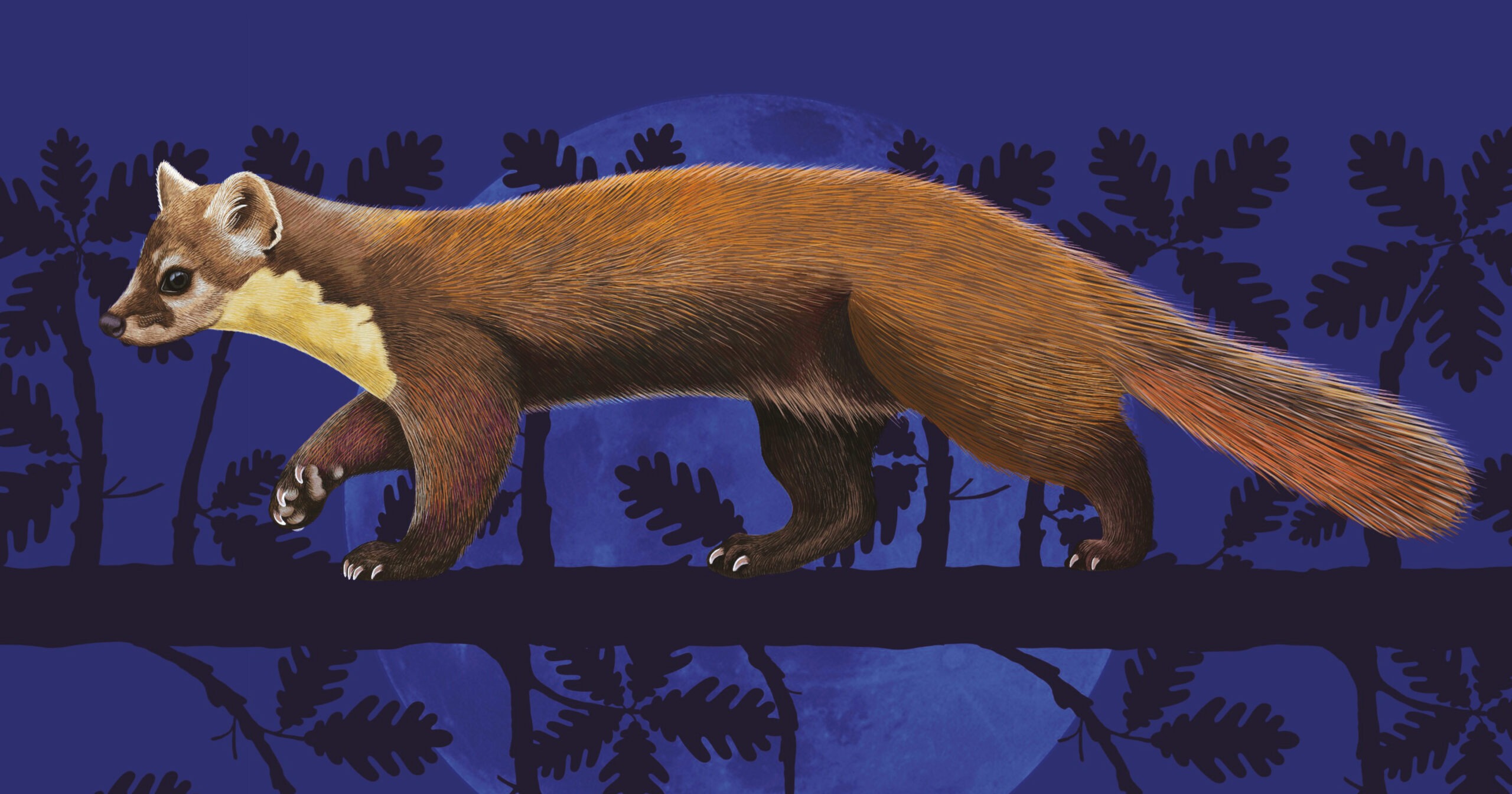
Smaller than a house cat, and twice as nimble, the pine marten is a dextrous ghost of the woods. If you didn’t come across its multi-coloured scat, you’d be hard pushed to know you were even sharing a forest with it.
The pine marten is a small, omnivorous predator that’s widespread across the world. Mic Mayhew, project manager at South Cumbria Pine Marten Recovery Project in the UK, explains that members of the pine marten family are at home ‘from the Pacific North West right across the States, Europe and Asia’. In the UK, they have been present and prevalent for thousands of years. In fact, Mic describes them as ‘previously one of the most numerous small carnivores since the Ice Age’.
However, the story of the pine marten in the UK is sadly similar to many other species. Due to habitat destruction and hostility from humans, the animals dwindled in the wild. Victorian game-shooting estates hunted them with hounds in the 19th century. During the last hundred years, the population in the north of Scotland has recovered, but in England and Wales it shrank towards extinction.
Mic hopes this rapid decline is fleeting. He explains that pine martens have ‘existed for thousands of years; they have been extinct for a blink of an eye in evolutionary terms’. He has worked with conservationists across Britain to relocate pine martens from the Highlands of Scotland to release sites in south Cumbria. His own project rehomed just under 30 individuals, but this is part of a much wider initiative, with the hope that the rehomed populations ‘meet, mingle and interbreed’. This approach will give the animals a greater chance of survival than if they were isolated groups. Mic says there are really positive signs: ‘It is happening already – the natural population in the Kielder Forest, Northumberland and our pine martens in north Cumbria are already meeting.’
Keeping track
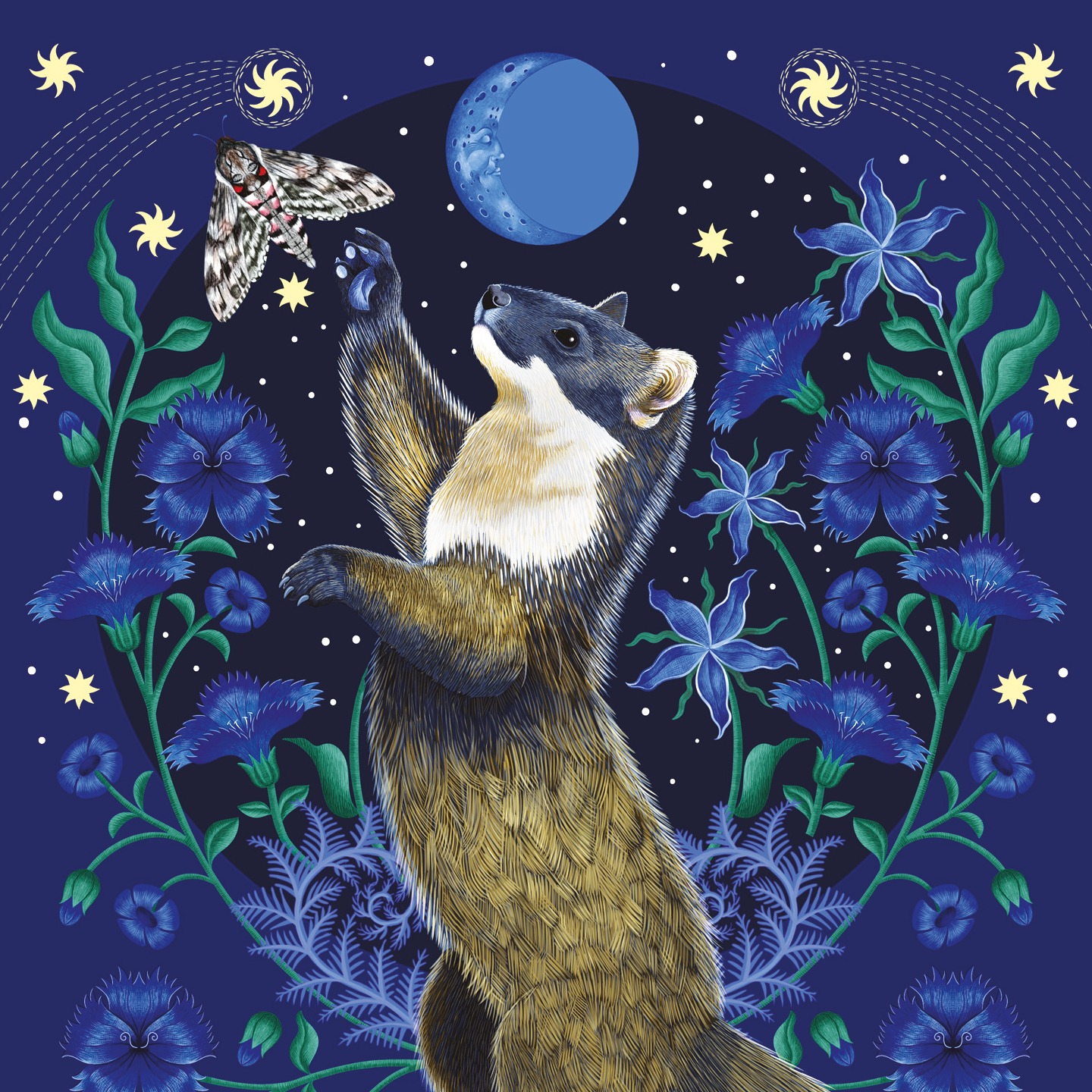
Given the extent of their movement, it becomes very important to track these animals. However, pine martens are notoriously difficult to spot in the wild, as they are nocturnal and solitary. Scientists use special camera traps to help, which Mic explains they bait with a particular favourite: ‘They’re real suckers for peanut butter!’ The camera traps are set up so that to get at the tasty treat, a pine marten must stand on its hind legs, which gives the camera a good look at its chest. The light patch of fur on its throat is called a bib, and it is uniquely shaped, rather like a fingerprint, which means individuals can be identified. Mic says that a UK database of bibs is currently being created so that these elegant creatures can be tracked across the country.
Getting the public on board
But before the project could get under way, there was important work to be done to win the hearts and minds of local communities. Mic explains that getting local people on board was vital to making sure these initiatives would work, and initially ‘some sectors in the rural community felt very concerned and threatened’. Although public opinion is largely in favour of reintroduction projects, this is not always the case for specific rural populations. ‘If you take a questionnaire into a city and talk about reintroducing charismatic, beautiful creatures, you will find 90 percent support. All they see are beautiful animals, and town dwellers are not in any way impacted,’ says Mic.
However, Mic emphasises the importance of taking the concerns of rural communities seriously, as they’re the ones who could be affected. Pine martens are hunters, and concerns were raised about potential predation on livestock, game birds and local wildlife such as smaller mammals and birds. Farmers were worried about the safety of their lambs and calves, but Mic says this misconception began to be addressed by explaining the average pine marten weighs just 1.3-1.4kg. Pheasant and chicken farmers needed reassuring because although not a core part of a pine marten’s diet, they are capable of killing these birds, just as foxes and weasels do. Sharing information about simple and cost-effective solutions to prevent this, such as fixing wire mesh over chicken runs, helped to reduce local concerns. Wildlife Trusts across the UK also offer reassurance that the reintroduction of pine martens will help to restore balance to local woodland ecosystems.
In the west
Another scheme working alongside Mic’s is the Two Moors Project, bringing back pine martens to Dartmoor and Exmoor in Devon, south-west England. This project commissioned local artists and creatives to develop community engagement projects that would increase awareness and support for the reintroduction of pine martens. Rita Pierson, founding member and board director of The Wool Hub, a craft centre in the town of Buckfastleigh, was inspired to help. Although Rita is not a conservationist or scientist, she recognised she could play a meaningful role. ‘I thought, “I can do something!” – something beautiful and something useful and informative for everybody.’
Rita organised workshops for local children and their families, and together they created a large felted play mat, as well as toy pine martens and other animals to play with on the mat. Wet felting with sheep’s wool, Rita explains, is ‘the oldest material-making process in the world – it’s what nomadic people used to make yurts’. The plants and creatures for the play mat were created using dry wool felting, which is a very different process involving special felting needles.
In this calming, creative atmosphere, conversation flowed naturally, says Rita. ‘During the felting sessions, the conversations were about these creatures, and all sorts of questions came up. We needed to study the animals’ anatomy in great detail, so we learned a lot.’ Although the idea had originally been to make only pine martens, they decided to add lots of other animals as well. This way, they could show how the return of the pine martens affects the whole ecosystem.
The wider picture
As Mic explains, the pine martens are just ‘a tiny piece of an enormous jigsaw to recover nature. Where pine martens recover, the grey squirrel population declines and then the red squirrels recover… Pine martens and red squirrels have co-evolved and co-existed for thousands of years. Reds have developed predator avoidance behaviours, which greys haven’t, and so pine martens disproportionately kill the greys. Vast amounts of money are spent every year to control the grey squirrels, and the pine martens do it so well.’
In this way, reintroduction projects are not only about the species being relocated but, as Rita puts it, ‘about all of the moors’ inhabitants’. Her groups created all manner of animals so that the play mat could become ‘an amazing array of wildlife’, to match the area they were representing.
Families were then invited to play with the mat and toys, and tell stories based on the pine martens’ return. ‘The children named the pine marten Pippa, and talked about her long journey all the way from Scotland. Every time we got out the mat, they set it up differently. There was so much scope for imagination – stories arose, and we had so much fun.’
Devon Wildlife Trust is now using them in lectures and public engagements, and the mat is a huge hit, even with adults. ‘They can’t get enough of it!’ laughs Rita.
Human connection
The return of pine martens across England signals just a small part of nature’s recovery, but has had a profound impact on the humans involved. For Rita, who knows that the scientific side of conservation isn’t for everyone, it has been through engaging people with creativity that she has found her passion for the pine marten’s story. It is a powerful experience. ‘When people make something with their hands, especially using natural materials, they develop a deeper connection to wildlife and the landscape… That sense of participation can make conservation feel more personal and meaningful. Art can gently bring conservation into community spaces and everyday life.’
Mic talks about his journey to conservation as a calling. He started his career as a vet but after witnessing ‘the insidious collapse or disappearance of nature, I felt a sense of mourning and loss that is difficult to put into words. I felt a calling that I should do something about it. I quit, sold the vet’s practice and retrained as a conservation biologist.’ Now, as the pine marten project continues, he talks about the ‘enormous privilege of having close encounters with pine martens. They are exceptionally rare.’
This close experience with nature is one that he shares with a wider team of staff and volunteers, ‘remarkable people’. He speaks specifically about one young woman: ‘She came from the city and had no knowledge of wildlife, but had found a wonderful character called Tom on an online dating site. He was a forester who lived in a cabin in our area. She came with a diagnosis of cancer and volunteered with us, but died very young. I remember the way she spoke. She was thankful for the opportunity to experience the woodlands. The project provided her with an intimate and novel connection to nature that she had never experienced before. And that was very special.’
Keep up to date with Mic’s project on Instagram @south_cumbria_pine_marten and on Facebook @South Cumbria Pine Marten Recovery Project
Find out more about Rita at thewoolhub.org/about-7 and follow The Wool Hub on Instagram @thewool.hub