
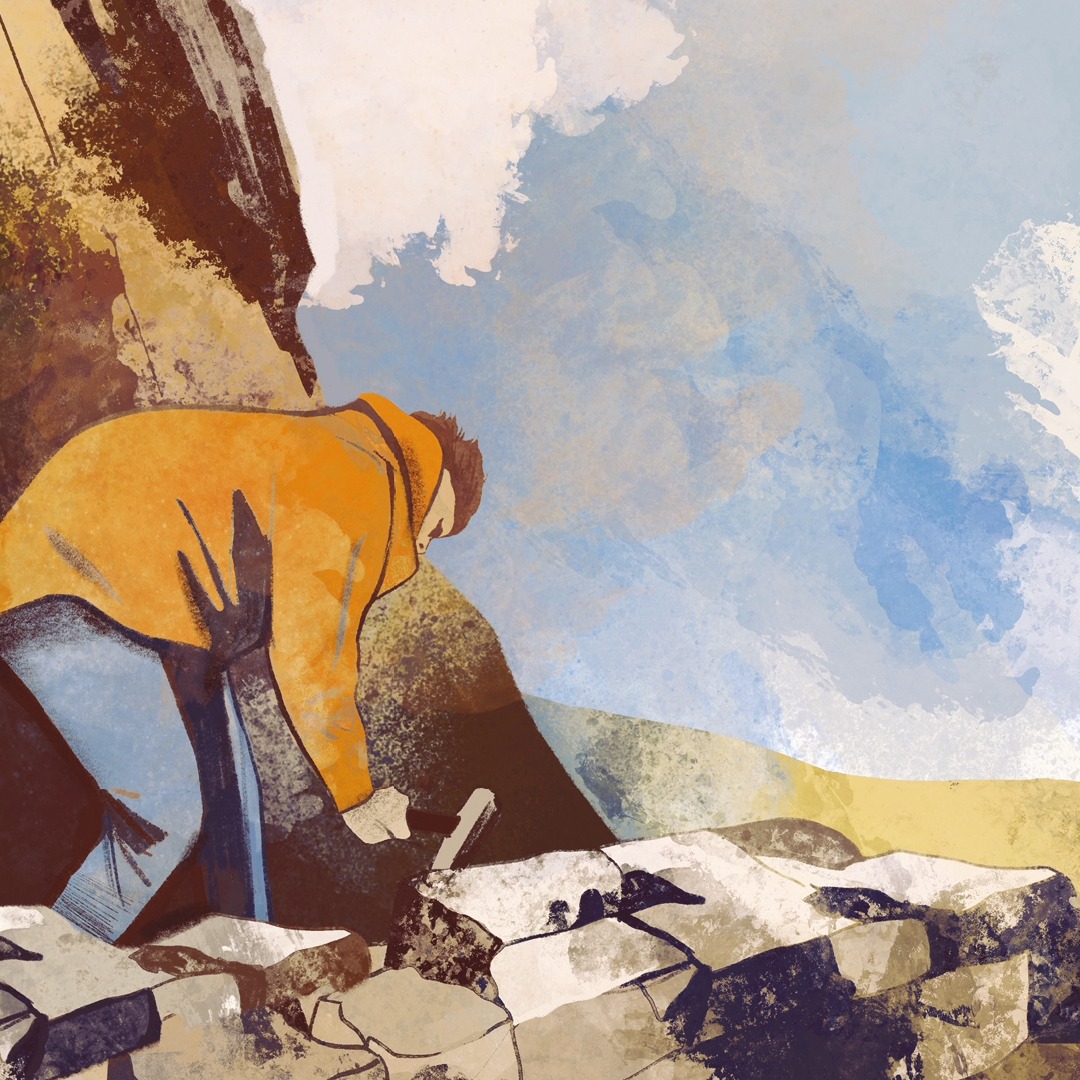
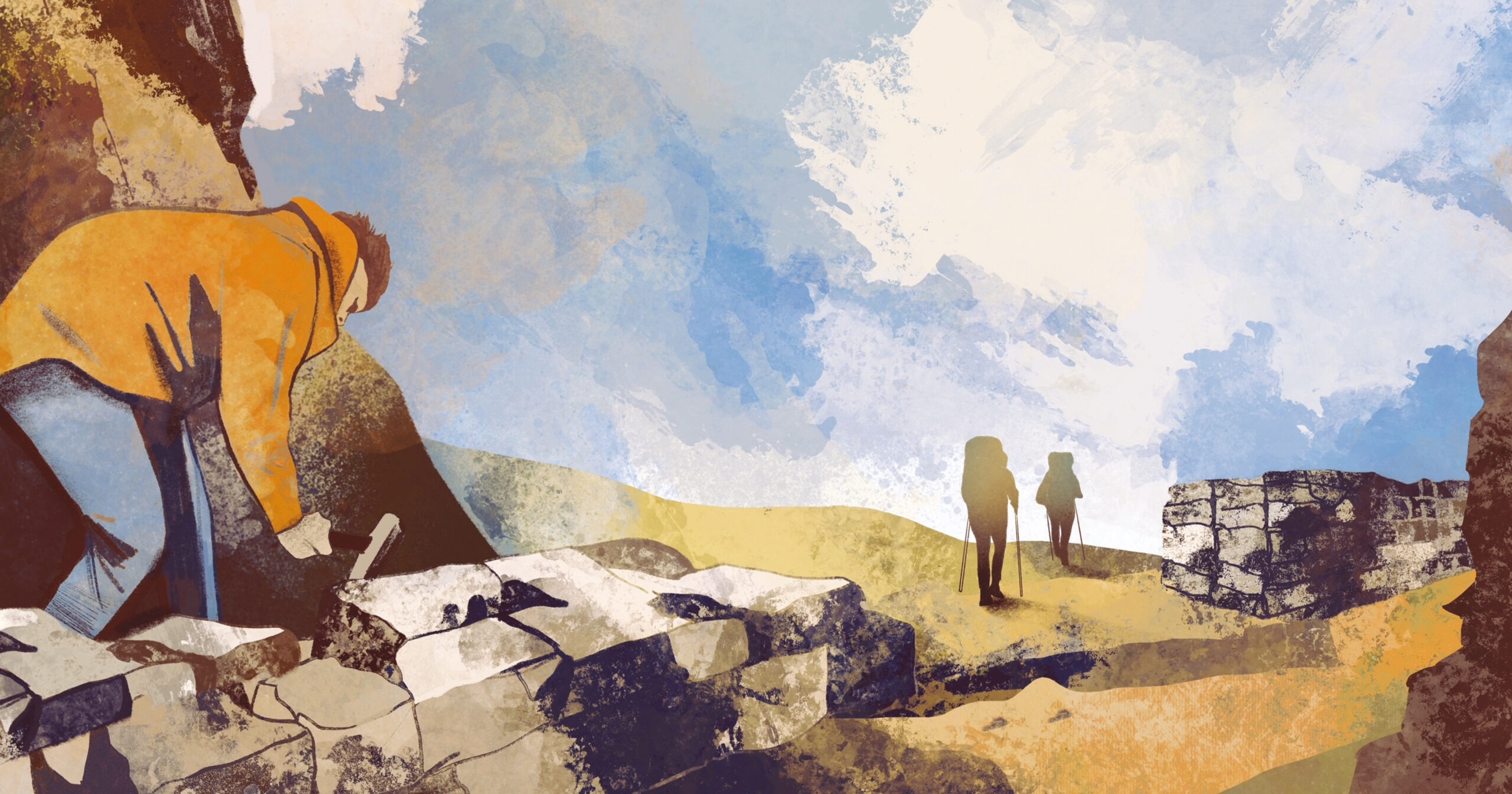
In some of the most remote landscapes, it’s a source of wonder to find stone walls meandering for miles, almost stitched into the fabric of the hills and dales. Hunkered against the elements, they stand testament to the skill of those who laid them.
The technique of building walls from locally available stone – without mortar, just careful craftsmanship – dates back thousands of years. Dry stone walls are still a common feature of the countryside in Ireland, Scotland, parts of England including the Peak District, Lake District, Northumberland and Cornwall, and around the world in parts of Mediterranean Europe and the Americas. And the art of dry stone construction has now been recognised by Unesco. An iconic feature of the landscape they traverse and bisect, these enduring boundaries still serve a purpose to farmers and landowners today.
Bridges to history
Ramblers and hikers will be familiar with following the line of a dry stone wall along the footpath, scrambling over precipitous ladder stiles to reach the other side, but many of the walls you encounter today were laid by hands that are long gone: shepherds, farmers and communities who existed hundreds, sometimes even thousands of years ago. According to the Dry Stone Wall Association, dry stone walling in Britain dates back at least three and a half millennia, to the village of Skara Brae in the Orkneys, and Iron Age settlements in northern and western Scotland. Meanwhile in County Mayo, Ireland, there are field systems that have been carbon-dated to the Neolithic period. Legislation and advances in farming led to the creation of more fields and boundaries, and many of the dry stone walls seen across the UK today were built between 1750 and 1850 during the time of the Parliamentary Enclosure Acts.
Across the world, dry stone walls were also rooted in rural cultures. In parts of Croatia, Italy, Spain, Greece and Cyprus, walls were used for terracing mountain olive groves and vineyards, and in Japan and the Americas there were also used in enclosure and agriculture. In 15th-century Peru, the Incas were known for their precise, mortar-free ‘ashlar’ masonry, perhaps the most famous example being the World Heritage Site of Machu Picchu, high in the Andes.
Windswept boundaries
Dry stone walls are most often found in high and remote places, where hedges and trees don’t grow easily but stone is available as a building material, and fields are marked by clearing rocks and using them to form boundaries. In Derbyshire, there are approximately 26,000 miles of dry stone walls carving up the landscape of the Peak District, according to Peak District National Park, with the oldest dating back to the Roman, Iron and Bronze Ages. Today they’re integral to the historic character of the area, as well as providing essential durable land boundaries, shelter for livestock and helping to manage water drainage.
Sally Hodgson, from Glossop, has been a waller for 37 years; she holds the Dry Stone Walling Association’s Master Craftsman certificate and is a principle tutor at the National Stone Centre. ‘People are passionate about dry stone walls,’ she says. ‘When I’m out walling, so many people stop to talk to me about them. Or drivers pull over, wind their windows down and take photos. They wouldn’t do that if I was building a fence!’
A living part of the landscape
Sometimes described as breathable, the mortar-free construction of dry stone walls allows wind and rain to pass through the gaps, which helps to maintain their structural integrity. They can also shift with the changing landscape, subtly responding to subsidence, frost and even earthquakes. In 1994, Sally was awarded a scholarship from the Winston Churchill Trust and travelled to northern India and Norway to write a thesis comparing the construction of their dry stone walls. She found buildings in the foothills of the Himalayas built with a mixture of timber and dry stone walling. ‘During earthquakes, the buildings could shiver and shudder,’ she explains.
As they age, dry stone walls become part of the local ecosystem, providing shelter for animals, birds and insects. According to the Yorkshire Wildlife Trust, there are around 5,000 miles of dry stone walls across the Yorkshire Dales, and the small gaps within them provide spaces for nesting birds, small mammals like mice, shrews and voles, and hundreds of invertebrates such as beetles, spiders, woodlice and centipedes. Sally describes them as ‘brilliant bug hotels’, and on her family farm a little owl nests and has its chicks in one of the boundary walls every year.
There are also benefits to livestock, with walls in high, exposed places offering welcome windbreaks against rain, snow and wind for cattle, sheep and horses. ‘If a lamb is born sheltered by a dry stone wall in a storm, it’ll survive, but it if was born behind a fence it wouldn’t stand a chance,’ Sally says.
‘The weather on one side of a dry stone wall can be as different as night and day from the other,’ agrees Andrew Rooney, who with his brother Brian is the fifth generation of wallers at Thomas Rooney & Sons Stonemasons in Northern Ireland’s Mourne Mountains. Andrew adds: ‘As an emergency shelter they can be lifesaving – not just for livestock, but for hikers and people stuck up the mountains in storms.’
A crucial craft
Although dry stone walls are built to stand the test of time, maintenance is crucial, and Unesco has added dry stone walling to its Representative List of the Intangible Cultural Heritage of Humanity, as a living tradition that connects modern people with past generations. Building and maintaining dry stone walls requires an understanding of geometry and physics, as well as the skills to handle the raw materials.
‘Construction is achieved through the careful selection and arrangement of stones to ensure the long-term stability of the structure and its adaptation to the local terrain and climate,’ cites the organisation.
In Northern Ireland, Andrew and Brian maintain the Mourne Wall, a 22-mile extent of dry stone wall built over almost two decades from 1904 to 1922 to enclose a catchment area of the Silent Valley reservoir. ‘It’s a listed monument now,’ says Andrew. ‘The wall itself is magnificent – we are in awe of it.’
Andrew describes it as a ‘very physical and labour-intensive job’, working with Mourne granite and often at steep gradients and altitudes. There are different techniques and types of dry stone walls, stemming from different local traditions geographically, he explains, but he likes to start with strong foundations about a metre wide. He then works upwards, creating two ‘skins’ of large stones at either side of the wall and smaller ‘hearting stones’ filling the centre. ‘The middle is so crucial, it’s where the strength and structural integrity comes from,’ he adds.
Sally is one of the founders of Walls for the Future, which set out to provide training in dry stone walling in the Peak District. She says she loves the challenge of the job, because every wall is so different. ‘You get a clue when they were built from the shape of the fields,’ she says. ‘The large rectangular fields were from the Enclosure Acts, but the smaller walls built closer to homesteads and cottages can be much older.’
Sally has also made interesting discoveries, likely left behind from previous generations of wallers. ‘I’ve found two sets of false teeth in walls, loads of glass bottles and of course lots of fossils in the limestone,’ she says. ‘I once found an unexploded hand grenade hidden in a wall, and had to call the bomb squad!’