

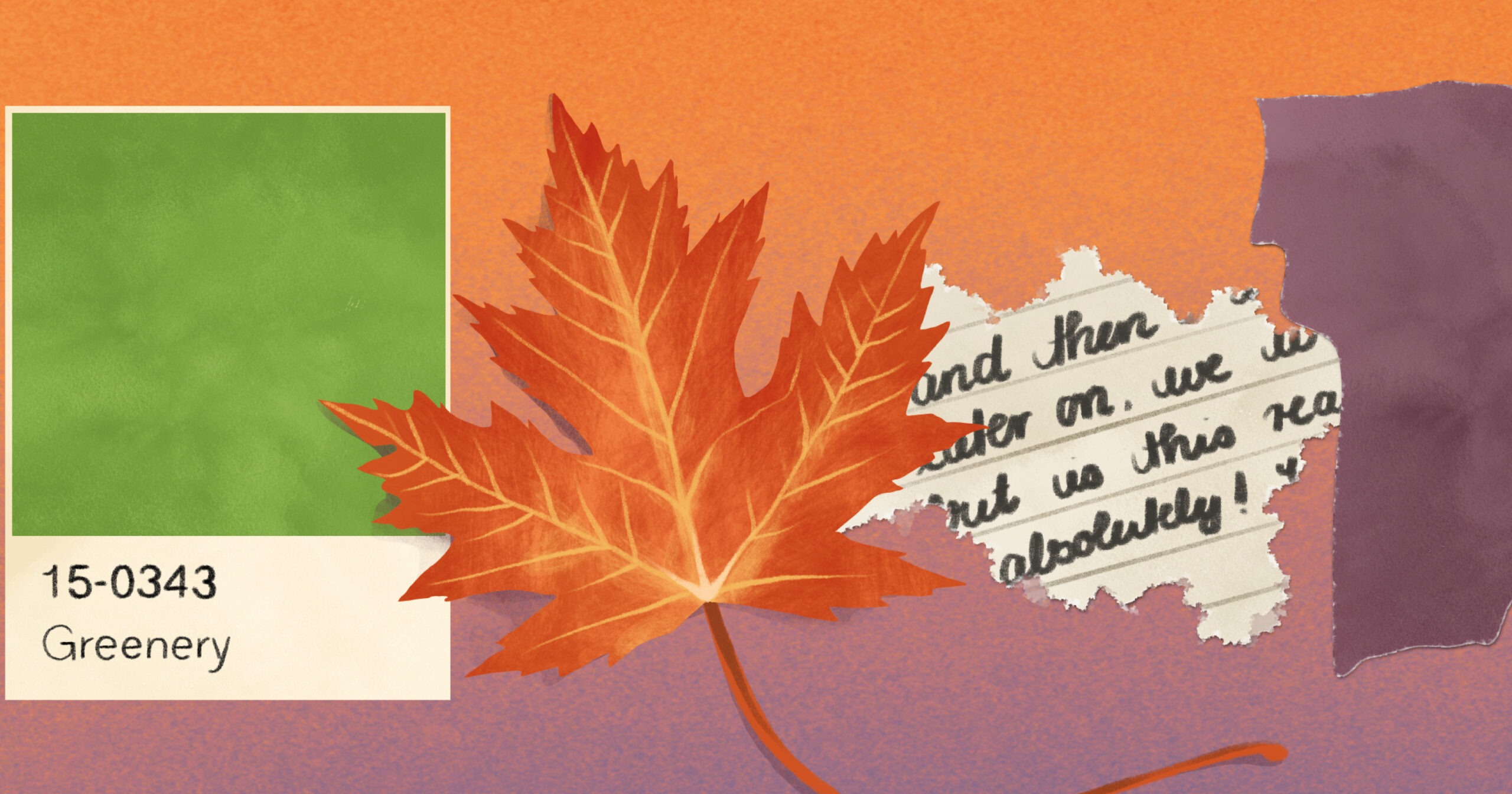
For a long while I saw journalling as a way to capture what had already happened – a place to record the past, to sift through thoughts and try to make sense of tangled feelings. Just as when I began junk journalling, I thought it was simply a way to use up scraps, a creative excuse to repurpose paper, packaging and little treasures that seemed too lovely to throw away.
But over time, as the pages became thicker, I began to see it differently. My junk journal wasn’t just a collection of odds and ends: it was quietly becoming a creative companion. It held the beginnings of new ideas, half-formed sketches, colour swatches, tiny notes in the margins. Without realising it, I had been journalling my way into new creative projects all along. It has slowly emerged as a creative compass.
Inside those layered pages were hints of new ideas waiting to surface – fragments of colour, texture and emotion that gradually began to take shape as projects of their own. Scrap by scrap, I came to understand that junk journalling is more than a pastime: it’s an art form, a bridge between thought and creation.
A creative companion
A journal has no expectations. It doesn’t demand perfection, and it doesn’t care if your handwriting is neat or your ideas are not fully formed. It simply holds space for whatever arrives. In that freedom, creativity starts to breathe again.
When I open my journal now, I see it as a kind of laboratory – a safe, private space where ideas can be playful, messy and full of possibility. It might start with something small: a word that feels right, a fabric scrap I’ve glued in or a colour combination that makes me feel something. Those small moments are often where my next project begins to take shape. You can start with what you already have – an old notebook, a cereal box cover, envelopes, brown paper or ticket stubs. Everything is welcome.
There’s something grounding about having all your ideas gathered in one place – a kind of creative map that you can return to whenever you feel unsure. When I flick through the pages, I can often trace the thread of an idea forming long before I consciously knew what it was.
Each page becomes a conversation between the things you collect and the ideas you haven’t quite found yet. Unlike a blank sketchbook, a junk journal already has history built into it – the soft folds of recycled paper, the worn edge of a book page, the faint print of something that once had another purpose. It’s imperfect, and that’s what makes it beautiful. There’s something deeply satisfying about gathering what might otherwise be discarded and giving it a new story. As you layer paper, fabric and snippets of writing, the journal begins to develop a personality of its own. You stop worrying about what it should look like, and instead start noticing how it feels.
Where ideas begin
Creative ideas rarely arrive as lightning bolts. More often, they whisper. They hide between the lines of what we’re already writing, thinking or noticing. Journalling helps make those whispers visible. Maybe you start writing about your week and find yourself describing a certain colour that keeps appearing in your mind – the soft grey of a winter morning, or the burnt orange of fallen leaves. Or you return to the same shapes or materials over and over again. That’s the journal gently nudging you: this matters to you. That’s where the magic starts: in the quiet rhythm of tearing, gluing, layering and stitching. Junk journalling asks nothing from you except to play, and in that freedom, creativity blooms.
Through journalling, you start to notice patterns – recurring words, moods or images – and those patterns are the clues. They point you towards what you are ready to create next. You’re not forcing a new idea; you’re uncovering it.
Some of my favourite projects have started with nothing more than a scribble in my journal. A sketch of a hare turned into a felted piece; writing about the change of season and the colours it created became the theme for a workshop. Sometimes it’s just a note that says: ‘I miss working with my hands.’ That’s often enough to get things moving again.
There’s a quiet kind of satisfaction in looking back and realising that what began as a few notes or a scrap of fabric has turned into something real. A finished craft, a new workshop or even a collection of art. The journal becomes a record not only of your thoughts, but of your creative growth – a reminder that ideas often begin long before you notice them.
Of course, your junk journal doesn’t always need to lead anywhere else. It can simply be the project. The process itself is satisfying: gathering, arranging and layering. The pages become small artworks in their own right – each one unique, textured and filled with quiet meaning.
When you keep a creative journal, you start to see that creativity isn’t separate from everyday life: it’s threaded through it. It’s in the things you notice, the textures you collect, the words you write down almost without thinking. Similarly, junk journalling isn’t about waste: it’s about renewal. It’s about finding beauty in the overlooked, creativity in the ordinary and peace in the process. Every page is a chance to start again.
Gather your scraps, your off-cuts, your small forgotten things. Open your journal and begin to layer. Don’t worry about making it perfect. Just let your hands move, your mind wander and your curiosity lead the way.
Turning pages into projects
Once you start recognising the small sparks, junk journalling becomes a bridge between thought and making. Here are some gentle ways to let yours lead you into a new project:
Create visual mood boards in miniature
Glue in scraps of paper, magazine clippings, colour swatches or fabric snippets, allowing you to play with palettes of colour. Don’t think too hard, just collect what draws your eye. Over time you’ll start to see a visual theme emerge.
Gather materials that tell a story
Include old letters, ribbons, lace or fabric samples that carry memories. Later, they can inspire projects that weave in that same nostalgic feeling.
Collect creative prompts
Write down phrases, quotes or ideas that make you curious. They don’t have to be profound. Even a word like ‘softness’ or ‘wild’ can grow into something bigger.
Build idea pockets
Tuck small notes, doodles or sketches into envelopes or folds within your journal. When you’re ready to start a new project, open a few pockets and see what calls you.
Document your creative rhythms
Write about what you’re drawn to each season: colours, moods, textures. Over time, you’ll begin to see natural cycles in your creativity.
Each of these small acts builds a bridge between your inner world and the tangible world of making.