
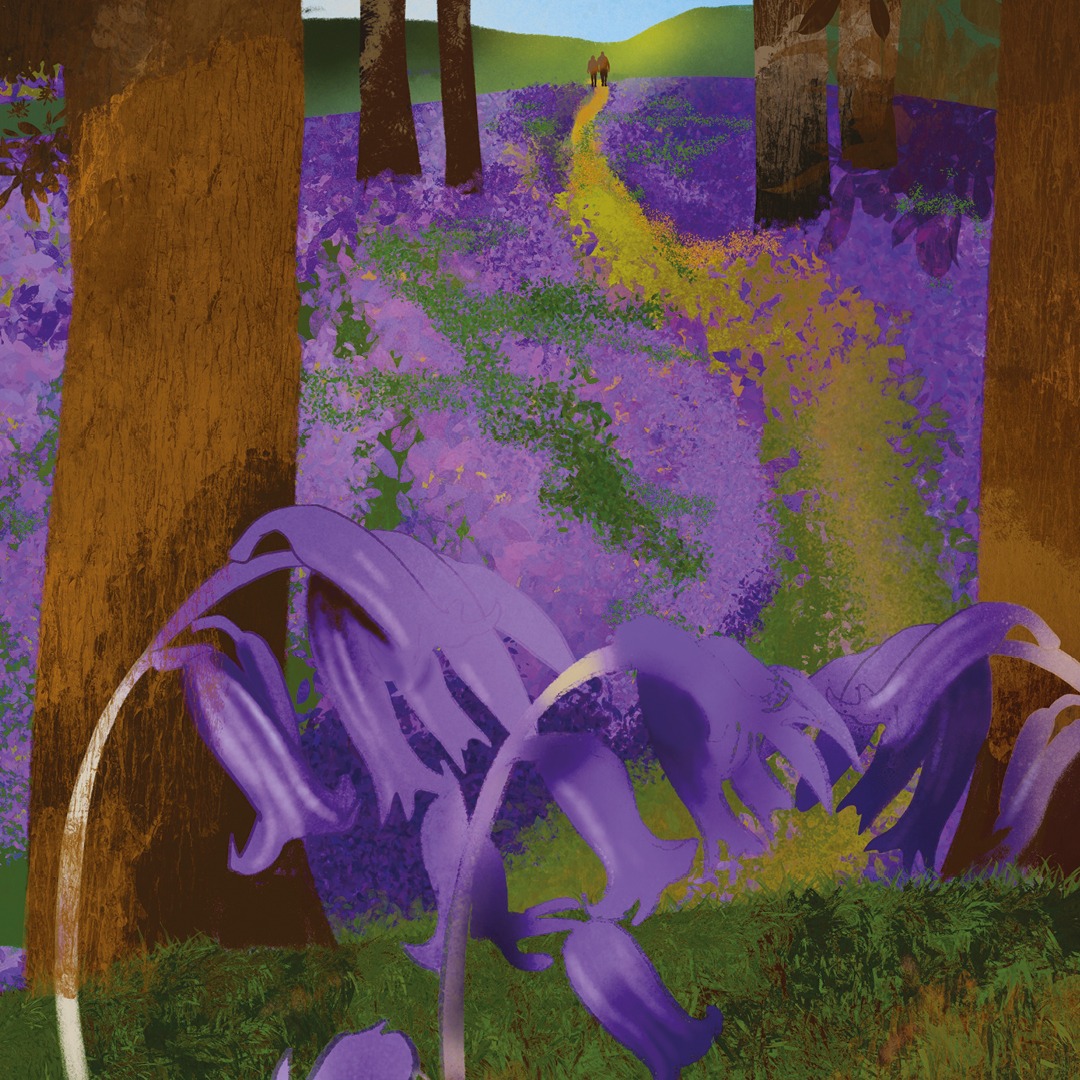
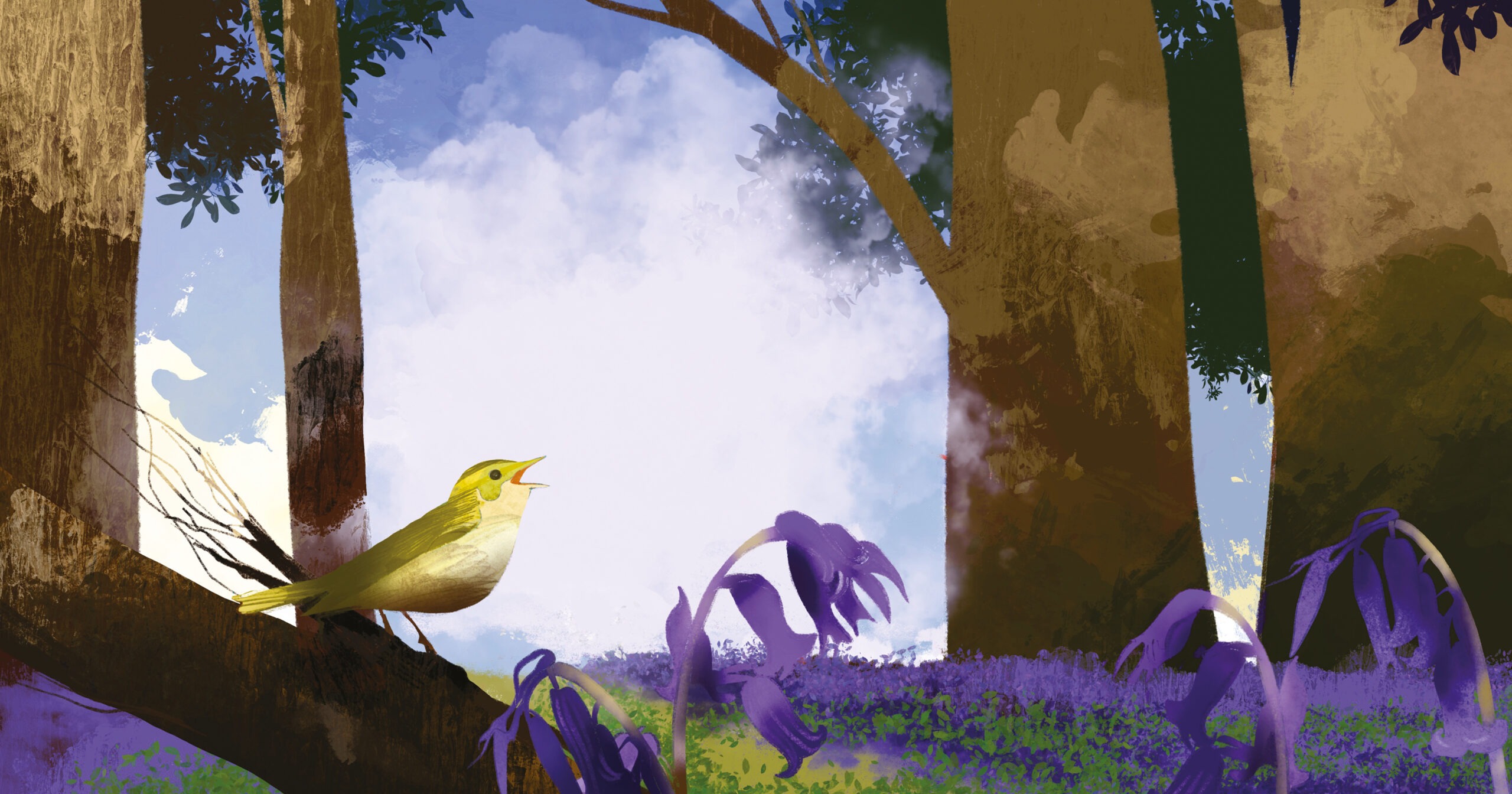
On a woodland walk in spring, there are few moments able to match the magic of stumbling upon a grove of bluebells in full flower. With their vibrant namesake hue and their sweet, earthy scent, these herbaceous perennials, which bloom for only a few weeks of the year, are a rare, spirit-lifting treat to be savoured.
English bluebells – sometimes called Atlantic or Common bluebells – have curved stems, with the sweet-smelling bells dropping over to one side, while hardier Spanish bluebells – which were introduced as a garden plant by the Victorians – are more upright, with wider leaves and paler, scentless flowers. There are also hybrid breeds, as well as Scottish bluebells, known as harebells, which are a different species altogether, although they share much of the same folklore.
Bluebells thrive in woodlands, and their presence (along with other factors) is often read as an indicator that woodland is ancient. English bluebells are rare, take a long time to establish (up to seven years from seed to flower) and are extremely delicate. Their soft, succulent leaves are particularly susceptible to damage and if crushed cease to photosynthesise, thus depriving the bulb of food and reducing its ability to produce flowers. For this reason, it’s illegal in the UK to intentionally pick, uproot or destroy them, even on private land, and visitors to bluebell woods are strongly urged not to wander among the flowers and instead stick to designated pathways. But if the conservation of these beautiful blooms isn’t enough incentive to enjoy them only from afar, then perhaps you must take heed of their magical associations…
Fairy folklore
In the cultural imagination there is a strong association between bluebells and fairy magic, much of which reinforces the need to treat bluebells with care: one folk belief states that bluebells ring out when fairies wish to summon each other, but that if the sound reaches human ears, the hearer will surely die. Another states that fairies hang their spells to dry on bluebells, and that the weight of them is what causes the flowers to droop to one side; if humans pick or disturb the bluebells, they risk unleashing the spell and unwittingly falling under the power of fairy magic. People were thus discouraged from walking amidst the delicate flowers, for fear that, so enchanted, they might never return.
In her book, The Fairies in Tradition and Literature (1967), influential folklorist Katherine Briggs describes this bluebell-induced intoxication as being ‘pixy-led’. While we like to believe these stories are ancient, it seems likely that many of them date back only so far as the Victorian era, when fairy lore was fashionable. One possible source text is even more recent: Beatrix Potter’s 1929 story The Fairy Caravan, in which the protagonist – an anthropomorphised guinea pig named Tuppeny – gets lost trying to pass through a bluebell wood on a horse-drawn caravan, wandering round and around in confusing circles for many hours. While fairies aren’t explicitly mentioned in the text, Potter’s accompanying illustration clearly shows them frolicking among the bluebells; the implication being that they bear some responsibility for Tuppeny’s plight.
A literary motif
Potter is by no means the first author to reference bluebells; the flowers have appeared throughout English literary and artistic culture. The poet Alfred, Lord Tennyson said they resembled ‘the blue sky, breaking up through the earth’, while Victorian designer William Morris included them in a number of his iconic fabric designs.
The image of the bluebell has been employed to reflect a variety of meanings: in Daphne du Maurier’s novel Rebecca (1938), the wild, natural beauty of the bluebell is contrasted with the cultivated glamour of a hothouse rose, foreshadowing the narrator’s transition from innocent girlhood to sexualised woman. Sisters Anne and Emily Brontë both wrote poems titled The Bluebell, using the flower in different ways as a symbol of the sadness and sense of loss which sometimes accompanies nostalgia.
In Anne’s poem, written in around 1838, she describes how, on a ‘toilsome’ day, ‘many leagues away’ from home, she feels restored by the sight of ‘smiling flowers’ when suddenly ‘a single sweet bluebell’ reduces her to tears, because it reminds her of ‘sunny days of merriment’ when ‘bluebells seemed like fairy gifts’. For Anne, the bluebell serves as a bittersweet reminder of childhood joy, now lost. For Emily, too, the bluebell acts as a symbol of happiness, made painful by its transience. As such, ‘the sweet Bluebell’ is ‘better far away’; ‘I know how fast my tears would swell/ to see it smile today’.
True love’s touch
It is apt that bluebells are associated with sadness in the Brontës’ poems, because a sense of loss is woven into their very name. The scientific name for English bluebells, Hyacinthoides non-scripta, is thought to be derived from Greek mythology: Hyacinthus was a handsome Spartan prince, beloved of the sun god Apollo. When he was killed during a discus throwing competition, a distraught Apollo attempted to prevent his descent into the underworld by creating a new flower – a hyacinth – from his spilled blood, inscribing the sorrowful cry ‘Alas! Alas!’ onto the leaves. The addendum non-scripta, which translates as ‘unwritten’, connects the bluebell to this legend, even while differentiating it; unlike the hyacinth created by Apollo, bluebell leaves are unmarked.
An association with romantic love, though, prevails: in the Victorian language of flowers, bluebells represented constancy, gratitude and true love. It was thought that if you were able to turn a bluebell flower inside out without tearing it, you would find your true love. Another belief dictated that placing a wreath of bluebells around the neck would compel the wearer to speak only the truth.
The glue that binds
Truth-telling and true-love finding were not the only historic uses for bluebells; they had other, more practical applications. Bluebell bulbs are filled with a gloopy, starch-like substance which was used in Elizabethan England to stiffen the elaborate collars and ruffs so emblematic of that era’s fashion – although at the cost of the laundry women responsible for applying it, who would frequently be left with painful, blistered hands as a result of the toxicity.
The sticky substance is also an effective adhesive, and is thought to have been used in fletching (ie attaching tail feathers to arrows used in archery) as far back as the Iron Age, as well as, until relatively recently, in bookbinding; indeed, the plant’s toxic qualities were thought to be beneficial in this application, as the poisonous bluebell glue supposedly repelled silverfish, thus helping to preserve the pages it held together. There are reports of bluebells being used by monks in the 13th century to treat leprosy, and they were also thought to be an effective treatment against tuberculosis and snake bite. Of course, due to its toxic nature, these applications were highly ill-advised.
An ancient and intoxicatingly beautiful wildflower, the symbolic power of bluebells far outmatches their physical delicacy and relative scarcity. Indeed, bluebells’ magic is made all the more potent by the fact that they flower for such a short time. This spring, be sure not to miss their brief enchantment.