
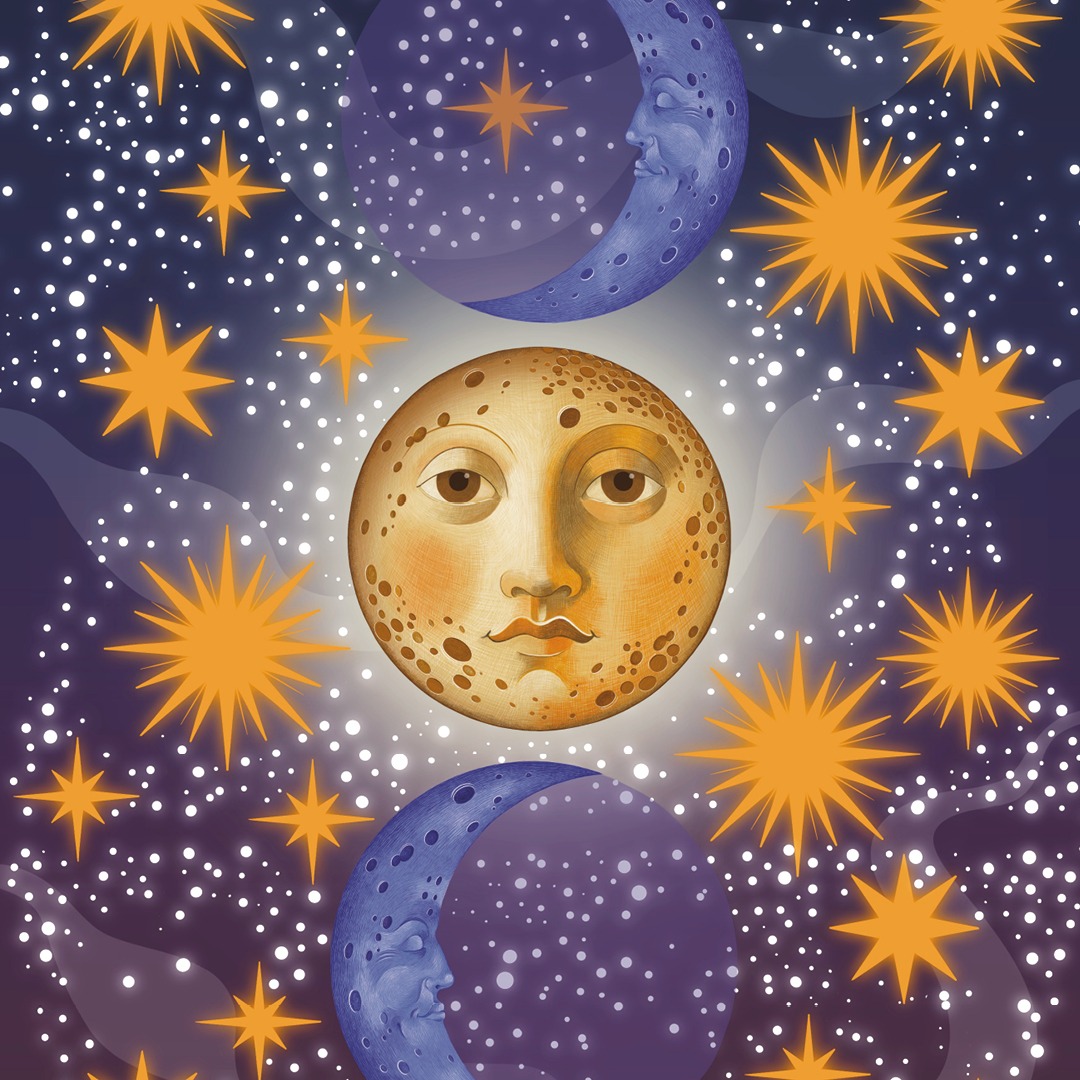
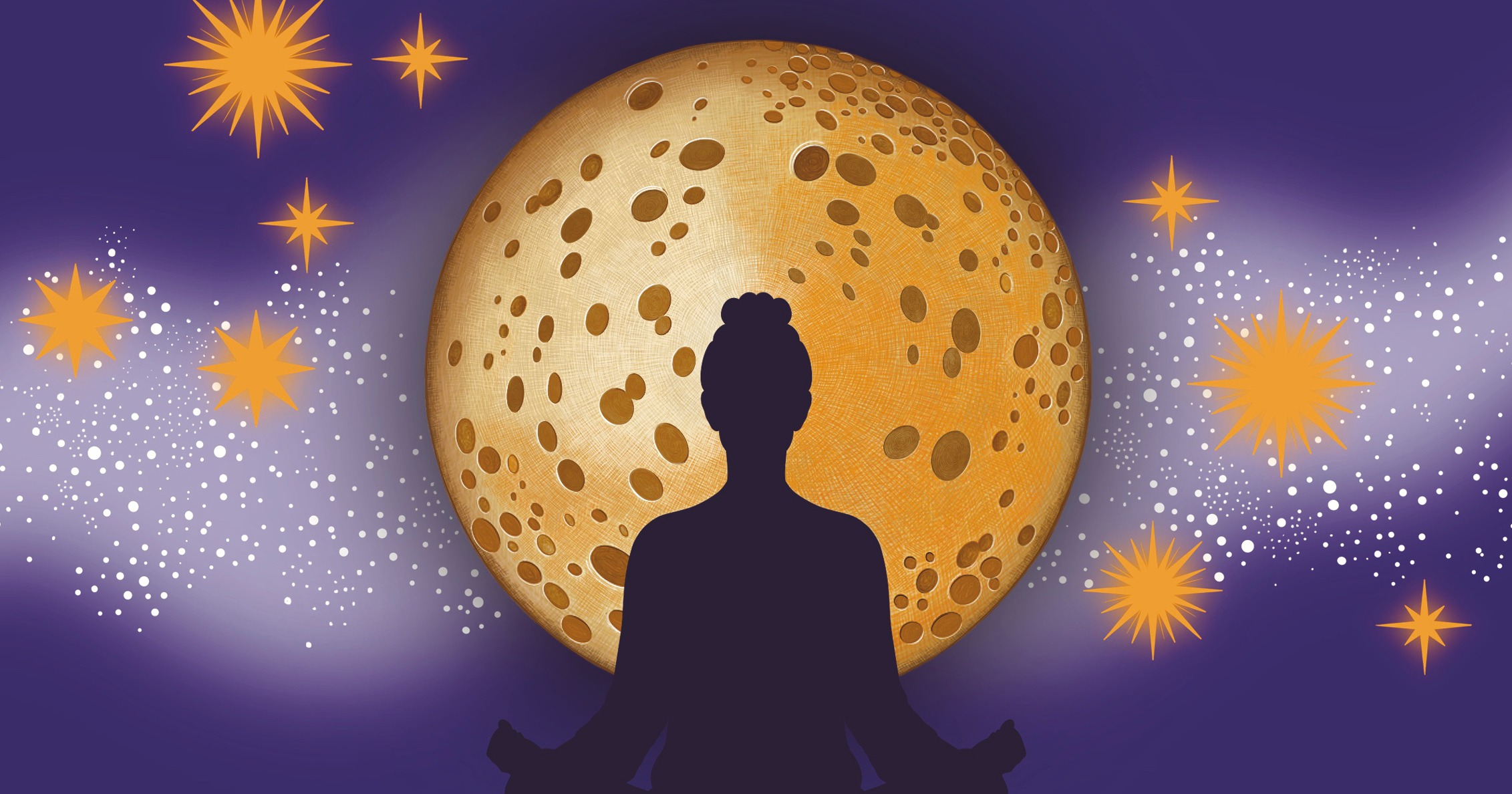
It’s night. The cool, autumn air kisses your face. All around you is quiet but for the gentle whisper of wind through nearby trees; the soft, sweet song of birds settling down for their nightly rest. You feel easeful, calm, as if some benevolent presence is watching over you. Taking in a deep, grounding breath, you look up and there she is, round and glowing in the wide, dark sky: the moon. At once familiar and mysterious, the moon has always been there, its waxing and waning a helpful reminder of the cyclical nature of things; a symbol of renewal and the healing power of time. Moon gazing – the mindful act of simply existing in the present moment with the moon – can be a powerful way of reconnecting with these ancient ideas.
Moon gods
A reliable yet ever-changing presence, the moon has played a significant role in the mythologies of many cultures. In ancient Egypt, for example, the moon god Khonsu was believed to be the son of the Earth (personified as the mother goddess Mut) and sun (the god Amun). According to Chinese legend, the goddess Chang’e took refuge on the moon after stealing a magical, immortality-bestowing elixir from her husband, Hou Yi. She resides there accompanied by a jade hare or rabbit, who, according to some versions of the story, prevents the angry Hou Yi from reaching her; in other versions, Hou Yi is heartbroken but remains devoted to Chang’e, honouring her from Earth through prayers and offerings. Chang’e continues to be celebrated in China each year at the Mid-Autumn Festival, which takes place during a full moon.
In ancient Greece, the moon was personified in the figure of the goddess Selene (known to the Romans as Luna), who was said to ride her horse-drawn chariot across the sky each night, in accordance with the moon’s phases. Many of Selene’s attributes were later transferred onto the goddess Artemis (Diana, to the Romans), twin sister of the sun god, Apollo. Artemis was goddess of the hunt, but was also protector of wild animals. In her position as moon goddess, she affords equal grace to each: when the moon is full, its illumination helps hunters more easily catch their prey, but under a new moon, the hunted creatures have the advantage, as they’re protected by its darkness.
Mother moon
As well as her associations with the moon, Artemis was known as the goddess of childbirth. Indeed, the moon is gendered female in many cultures, and a connection between the moon, childbirth, fertility and motherhood in general has long persisted in folklore and literature. Throughout Charlotte Brontë’s novel Jane Eyre (1847), for example, the moon features as an important symbol of change, fate and female intuition. In one pivotal scene, Jane has a vision of her dead mother, who visits her in the form of moonlight to impart comfort and sage advice. Similarly, Louisa May Alcott’s poem ‘The Mother Moon’ (1856) features a loving, maternal moon who protectively watches over the Earth.
A less benevolent vision of the moon is presented in Sylvia Plath’s Three Women (1962), a radio play in verse which features three voices describing contrasting experiences on a maternity ward: ‘There is the moon in the high window’ notes one; ‘it is she that drags the blood-black sea around/ Month after month, with its voices of failure’. Here, the voice blames the moon for her struggle to become and remain pregnant, tying in to the old association of the moon with fertility.
In Plath’s poem, the voice imagines her menstruation as a ‘blood-black sea’ controlled by the moon, drawing on a frequent assumption that the moon’s gravitational pull exerts a similar control over liquids within the human body as it does over oceans. (The moon’s role in causing tidal ebb and flow has been observed since at least as far back as the eighth century, when the Anglo-Saxon monk Bede described it in his treatise The Reckoning of Time, although the understanding that this is caused by gravity came later.) This has led some to believe that women’s menstrual cycles are linked to the phases of the moon, or that pregnant women are more likely to give birth when the moon is full. While there’s little scientific evidence to demonstrate this, some midwives and other health professionals assert it’s true of their own experiences.
Similarly, there are pervasive myths that instances of both criminal behaviour and mental illness crises are more likely to occur under a full moon; the word ‘lunatic’ (an outdated term for a person suffering with mental illness that is now considered offensive) derives from Latin, and literally translates as ‘moon struck’. Again, while science offers little evidence to back up such claims, there are law enforcement and mental health professionals who insist that it’s nonetheless the case.
What is certainly true, is that the moon is inextricably woven into the fabric of everyday life. The Earth’s journey around the sun gives us the measure of a year, but it is the moon, and the various stages it appears to pass through as it circles the Earth, that enable us to break that year down into manageable chunks of months and weeks; while the calendar is now more rigidly formalised, a ‘month’ originally referred to the interval between one new moon and the next. Indeed, in the English language this is reflected in the shared etymology of the words ‘month’ and ‘moon’.
In many ancient cultures, including Egypt, Greece and Babylonia, agricultural practices were planned according to the phases of the moon. This continued in Europe well into the medieval period; one agricultural treatise from 15th-century Spain dictates that seeds for melons, cucumbers, green beans and oats should be sown while the moon is waning, the theory being that its gravitational pull exerts an influence on the water-density of soil. Some modern farmers continue to use such methods today; in biodynamic farming, for example.
Moon rituals
There are many rituals and celebrations associated with the moon. In Christianity, the date on which the festival of Easter is celebrated each year is decided by the moon; it falls on the first Sunday after the first full moon after the spring equinox. In Hinduism, days which fall under a full moon – called ‘purnima’ in the north of India, and ‘pournami’ or ‘pournima’ in the south – are held sacred. Many Hindus choose to fast on these days, engaging in meditation and offering prayers to the god Vishnu.
Many neo-Pagans also engage with rituals based around the phases of the moon; typically, the waxing moon is associated with manifestation and intention-setting, while the diminishing energy of the waning moon is harnessed to release negativity, let go of emotional burdens and rest. According to Ayurveda, the ancient system of traditional medicine which originated in India, the moon possesses cooling, calming properties; practitioners often advise moon bathing (relaxing in the light of the moon) as a method of relieving stress and promoting relaxation. Moon gazing – the mindful act of focusing on the moon – can offer similar benefits.
Harvest moon
As the warmth of summer lingers into darkening evenings, and the leaf-fall gives a clearer view of the night sky, early autumn is an ideal time to engage in moon gazing. In fact, the closer you are to the autumnal equinox (when the sun is positioned directly over the Earth’s equator, meaning day and night are of equal length; in the northern hemisphere this occurs at the end of September), the earlier the moon rises and the longer the moon appears to be full, meaning an abundance of moonlight.
According to tradition, this extra illumination came at the perfect time for farmers, who were busy working to gather their crops; that’s why the first full moon after the autumnal equinox is known as the ‘harvest moon’.
In this way, the moon is intimately connected with much of what defines the onset of autumn; a time for fresh starts (the new school year, the joy of a clean, blank page), but also a time for harvest, for gathering in and taking stock; celebrating what has been achieved and received so far, while also looking forward to and preparing for what will come next. For those seeking to honour this seasonal shift, moon gazing is an excellent place to start. So, step outside, breathe the fresh, autumn air and look up to find that special, silvery light.