
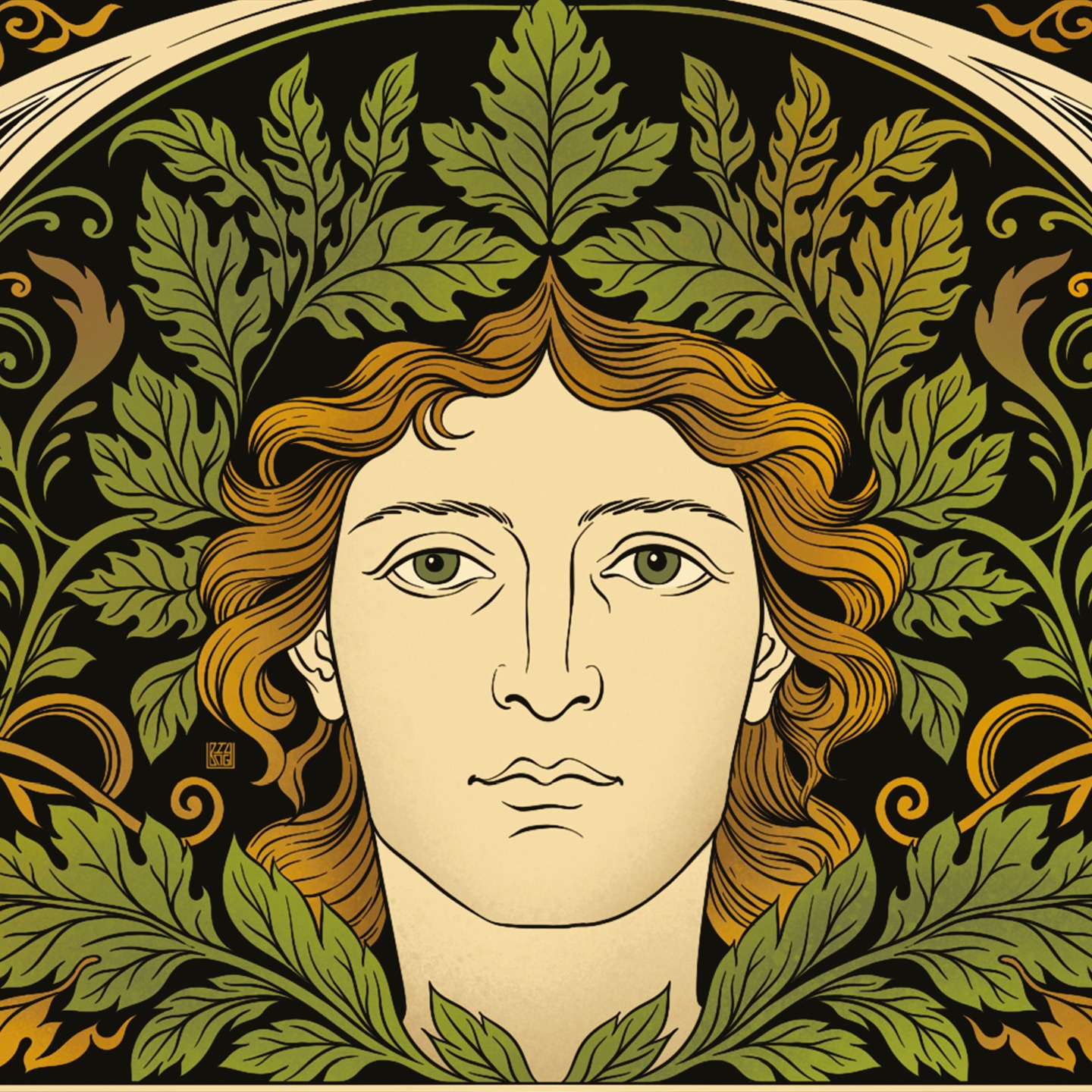
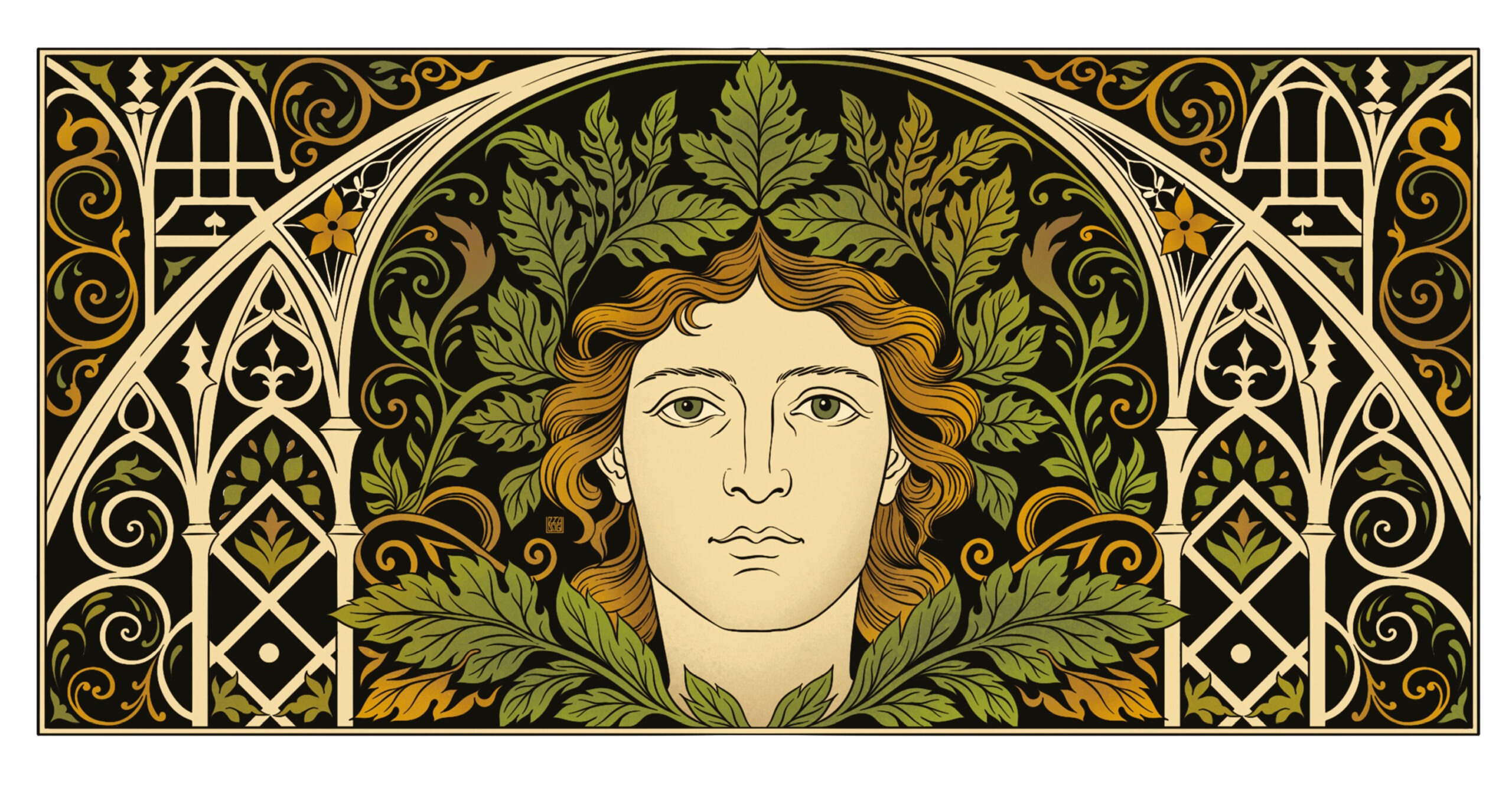
Carved into the walls of churches and other old buildings across the UK is a figure steeped in mystery. Sometimes he’s smiling; sometimes he looks pained. Perhaps he’s benevolent; perhaps demonic. But he is always surrounded by leaves – worn as a crown, forming his hair and beard or erupting from his mouth, nose, ears and even eyes. Who is this mysterious being?
Ancient roots
Foliate heads, as these carvings are called by folklorists and historians, date back to antiquity; there are examples from Roman architecture, including at the temple of Jupiter in the palace of Diocletian in Split, Croatia. Some experts have theorised that they may be depictions of the Roman god Silvanus, who was associated with wildness and the forest, but their precise meaning is unclear. Most foliate heads date from the Middle Ages; leaf-clad faces can be seen on the walls of medieval churches all over the UK and Europe. In Norwich cathedral in the UK, the foliate heads in the 900-year-old cloisters have been painted in vibrant colours to show how they might have looked when they were first made – smiling human faces peering out from behind large leaves in vivid green and gold. In contrast, a famous foliate head at the 13th-century Bamberg cathedral in Germany depicts a face which appears to be actually constructed out of leaves. Rosslyn chapel, in Midlothian, UK, has more than 350 foliate heads, including both of the above variations, as well as some disgorging foliage from their mouths.
Pagan traces
It was Julia Somerset, Lady Raglan, a British amateur folklorist, who first gave the name Green Man to these foliate heads. In her 1939 Folklore journal article ‘The Green Man in Church Architecture’, she drew a connection between foliate heads and the then-common green man pub sign, which, according to Ronald Hutton, professor of history at the University of Bristol, conventionally depicted a forester or gamekeeper. Lady Raglan, however, interpreted the pub sign to be related to European May Day traditions, drawing further connection to the still-prevalent inclusion of a Jack-in-the-Green during May Day parades. A Jack-in-the-Green is constructed from a wooden frame which is then woven with leaves and branches, so that the person who stands within it (to carry it in the parade) is entirely concealed by greenery – aside, usually, from a small peep hole. Lady Raglan argued that it was likely to be the sight of their friends and neighbours taking part in such traditions – traditions which, she theorised, had their origins in pre-Christian rituals – that inspired the medieval stone carvers to make their creations.
It was Lady Raglan’s assertion that foliate heads, as well as Jack-in-the-Greens and the folk hero Robin Hood, who also regularly appeared in May Day celebrations, all led back to a single ancient deity: a pagan god of nature and fertility, worshipped in May to herald the spring. She argued that the predominance of foliate heads in medieval churches therefore served as evidence that ‘unofficial paganism subsisted side-by-side with the official religion’ during the period.
Other folklorists suggested that the Green Knight in the anonymously authored medieval chivalric romance Sir Gawain and the Green Knight was also an expression of the Green Man deity she described. In the poem, a towering stranger dressed in green challenges King Arthur’s men to a game: one of them may behead him now, but only on the condition that in a year’s time he will behead them in return. Gawain accepts the challenge, but is surprised when the Green Knight, after receiving the fatal blow, simply laughs, tucks his decapitated head beneath his arm and bids farewell. The knight’s ability to remain unaffected could be read as an allegory for the continuation of pagan practice in the face of efforts by the Christian church to eradicate it.
Nature god
Lady Raglan was not the first to suggest that paganism was being practised in medieval Europe. However, in his 2022 book Queens of the Wild: Pagan Goddesses in Christian Europe, Hutton explains that the theory of an undercover paganism extending into the Middle Ages was first conceived by the Victorians, and is, in fact, unfounded. He argues that the idea felt particularly attractive to a generation who, in the wake of the Industrial Revolution and the sudden shift from a predominantly rural population to an urban one, felt anxious about their disconnection from the natural world. The myth of pagan survival took hold well into the 20th century; Lady Raglan’s notion of a pagan nature god whose cult persisted alongside Christianity fitted perfectly with the prevailing perception of medieval religious culture, and played a part in shaping the beliefs and practices of the neo-pagan groups that were growing increasingly popular in her time. By the 1990s, the Green Man was firmly established as a deity associated with nature and fertility within the burgeoning neo-pagan tradition.
The Green Man was also adopted by another group in the second half of the 20th century: activists campaigning to raise awareness of the impending ecological crisis, and the horrors likely to be wrought upon the world by climate change. The intersection of humanity with the natural world that the foliate head so perfectly encapsulates made it an ideal symbol for this movement. This association persists today, for example, in the music festival Green Man, which has taken place in Wales since 2003. Each year they burn an effigy of a foliate-headed man in honour of their namesake, and the festival places sustainability and environmental awareness at its heart. Similarly, King Charles III, who is known for his interest in preserving the natural environment, featured a foliate head on the invitation to his coronation in 2023. This was described in a press release as ‘the Green Man, an ancient figure from British folklore, symbolic of spring and rebirth, to celebrate the new reign’.
Ambiguous gift
The mystery of the Green Man prevails. Some have argued that medieval foliate heads are, in fact, Christian symbols, representing either (through the imagery of natural renewal) the miracle of Christ’s resurrection or, conversely, serving as a warning against the sin of intoxication (leaves were associated with alcohol in medieval culture). Others have posited that the Green Man is best viewed as a sort of folk saint – a figure with pagan roots, whose meaning evolved to fit Christian ideology. Perhaps, as Hutton has suggested, the simplest way to understand him is as ‘a figure used simply for its artistic and structural potential which had not only no fixed, common or agreed meaning, but actually no meaning at all’. And perhaps this absence of meaning should be taken not as a lack, but as an opportunity: foliate heads are ancient, potent symbols, conveying whatever meaning we most desire, or require, to find.
The Green Man in art and literature
Five depictions of the Green Man to explore:
Songs from the Wood, by Jethro Tull (1977)
Part of the 1970s revival of interest in the natural world, the countryside and environmental issues, this folklore-inspired, mystical album is the tenth from a band named after an 18th-century agriculturalist who invented a revolutionary seed drill. Jethro Tull’s main writer and singer Ian Anderson had recently moved from the city to the countryside, giving him time to rediscover earlier interests in folklore, rural themes and traditional acoustic instruments. The album as a whole has been described as a song cycle and includes a track called Jack-in-the-Green, while the lyrics suggest whimsical encounters with Green Men, wild huntresses and druids.
The Green Man, by Kingsley Amis (1969)
Amis’s tenth novel follows Maurice Allington, alcoholic landlord of the eponymous pub, who experiences ghostly visions of his predecessor in that role – Thomas Underhill, a 17th-century murderer and sexual predator who, it transpires, had an interest in the occult. The Green Man himself appears at the novel’s climax, a menacing figure constructed of twigs and leaves, threatening to kill Maurice’s teenage daughter. Amis seemingly adheres to the arguments made by some Christians that the foliate heads in churches were put there to dissuade congregation members from engaging in ungodly behaviour.
Green Man, by Tawny Gray aka Toin Adams (2002)
Created by the African artist Tawny Gray (who also goes by the name Toin Adams), this 40-foot-high sculpture is an iconic presence in Birmingham, UK, and is also the city’s tallest statue. The main body of the sculpture is constructed from stone, and also features fossils and plants. Green Man is designed to be a living sculpture, its appearance evolving and adapting with the seasons, as plants flourish, then die and decompose, and stone darkens or lightens according to how wet the weather is. As well as introducing an element of the natural world to this otherwise urban environment, he stands as a symbol of regeneration in a neighbourhood that had fallen to neglect, and has since been reinvented as a gathering place for the city’s creative community.
Lanny, by Max Porter (2019)
Exploring the disappearance of a young boy from his home in an English countryside village, Lanny is a highly unusual and formally innovative work of fiction, which communicates its story through a series of short, often seemingly disparate vignettes. The Green Man is reimagined as Dead Papa Toothwort, an ambiguous trickster figure whose actions serve as a catalyst for the novel’s central emergency (and its eventual resolution). Toothwort frequently shape shifts, taking the form of a stone foliate head carved into the church, as well as, among other things, a blackbird, a rusty tin and, in one climactic scene, a generic, garden-centre-reproduction of a Green Man. The implication is that our prevailing notion of the Green Man is an oversimplified and inadequately flexible expression of humanity’s relationship to the natural world.
The Green Knight, directed by David Lowery (2021)
This film is an adaptation of the anonymously written 14th-century chivalric poem Sir Gawain and the Green Knight, in which the court of King Arthur is visited by a mysterious, green-clad man, who challenges the assembled party to a game of mutual decapitation. Some scholars have theorised that the Green Knight in this tale derives from the same pagan god as the foliate heads found in medieval churches – the entity commonly known as the Green Man. The film draws on the idea of the Green Man as a symbol of nature, contrasting his fearless strength and the verdant power of the natural world with the sickly frailty of King Arthur and his court, in doing so demonstrating the relative insignificance of human-constructed notions like heroism in the face of nature’s might.