
Look around the next time you’re out and about or on public transport: tiny earbuds and chunky headphones are everywhere. If you tuned in to listen to them, what would you hear? These days, rather than your eardrums being subjected to thudding bass beats, you’d be more likely to hear a history podcast or the mellifluous tones of an A-lister reading the latest bestselling novel.
The audioworld of commuters today is a far cry from days gone by, when audiobook cassettes seemed only to stretch to literary classics. Once you scratch the surface, it seems that everyone has a favourite podcast, series or audiobook, whether it be David Sedaris reflecting on litter-picking or Stephen Fry bringing a high-stakes Quidditch match to life in Harry Potter. The Guardian now includes an audiobook of the week in its culture section alongside books, TV series and theatre.
This shouldn’t be a surprise, since listening has long been at the heart of storytelling. Some of the most well-known examples are the oral poems of ancient Greece. Versions of Homer’s Iliad and the Odyssey and other epics were performed live to an audience before they were set down in writing. There’s plenty we don’t know about the circumstances of classical performance, but there’s evidence to suggest that the poems were recited in sections over several days rather than digested in a single sitting. When you think about it, it’s not all that different from how we might listen today.
The advent of audiobooks
You don’t need to go back as far as Homer to understand the appeal of story-listening. Starting in the 1840s, and ending only with his death in 1870, the English novelist Charles Dickens famously gave reading tours on both sides of the Atlantic, freely mixing lectures and passages from his own books. Dickens was nothing if not an expert in spotting the direction the market was going in – he was always adept at anticipating changing tastes – and this is a good way to understand the novelist’s recitations, suggests Edward Allen, associate professor in modern British and Irish literature at the University of Cambridge. ‘Sadly, Dickens didn’t live to see the innovations of Thomas Edison; but we might take Dickens’ reading tours as proof that he’d have been among the first to record himself when the science of phonography exploded in the late 1870s.’
Is that the moment audiobooks became a thing? ‘Well, yes and no,’ says Edward. ‘The technology of sound storage took some time to perfect. Edison and others didn’t have a focused sense as to what use people would make of the phonograph [later the gramophone], and the materials themselves – wax cylinders and later discs made out of early plastics – had very limited capacity; only a few minutes could be preserved. Even so, the idea that stories might be etched onto a disc of some sort really took hold of the public’s imagination.
‘Science fiction writers at the end of the 19th century, such as Edward Bellamy, built the technology into their stories long before the technology was actually a commercial possibility; the very concept of allowing a recorded voice to guide you, to soothe you, was something of a fantasy. It was the same for Bram Stoker: Dracula (1897) gives us a fascinating insight into the technology’s potential for dictation and confession, at least as it seemed to a bloodthirsty Victorian!’
So how did we get from Dracula to the audiobook of Harry Potter, I wonder? ‘Things began to pick up speed in the 1930s,’ explains Edward. ‘All sorts of people could now see the possibilities of sound storage, from anthropologists engaged in fieldwork to those at the forefront of disability rights such as Helen Keller. As the technology underpinning “talking books” became more refined – vinyl became the material of choice, and 33 1/3 the favoured speed of revolution – companies began to exploit the greater capacity of long-playing discs. Much longer passages could now be accommodated, so that’s when you begin to see whole stories, plays and symphonies appearing on disc, not just single poems or songs. By the 1950s, it was only a short leap from the likes of Dylan Thomas’s radio drama Under Milk Wood [recorded in 1954, just weeks after the author’s death] to a novel recorded in the voice of its author.’
Benefits for wellbeing
With this history in mind, we now have the science to explain the booming popularity of recorded literature. As well as justifying all the work Keller and others did almost a century ago in advocating for talking books, an Iranian study from 2017 sought to gauge the impact of recorded literature on the elderly population, for whom deteriorating mental health is as much an issue as visual impairment. The study gathered evidence that audiobooks can have a positive therapeutic function, so much so that policy-makers might even look in future to incorporate ‘bibliotherapy’ into long-term treatment plans.
What is true of those who find the act of reading small print challenging may also be true more broadly of those for whom neurodiversity is a determining factor in their literacy. A survey by Listening Books, an audiobook charity based in London, reports similar positive effects to those described in the 2017 study. The statistics speak volumes: 98 per cent of members say having access to and listening to audiobooks helps them to escape for a while and forget about everyday problems; 94 per cent say being a member of Listening Books has improved their mental health.
It’s clear that Listening Books is a lifeline for users: as one listener reports, ‘membership has given me back my love of reading. For such a long time, not being able to hold or read physical books for more than a few minutes has inhibited my reading and made it less and less relaxing. But now, I can enjoy listening to an hour or two of an audiobook each evening to help me wind down for bed, and that is really improving my quality of life.’
Another describes using audiobooks to manage their ADHD symptoms. ‘I have ADHD to a pretty high scale in terms of the hyperactive part – I am either hyperfocusing or having a really hard time. Because of my schedule, I’m very rarely in the frame of mind that allows me to sit and concentrate on a book, although I was an avid reader. Audiobooks are great because I can listen and be active, draw or do something else so I can concentrate, but they are also very expensive. Listening Books has allowed me to get back into that, in terms of both informative books and also to relax. I recently completed [Terry Pratchett’s] Discworld series, which I never could have done otherwise. What’s been really nice is I used to end up watching YouTube or podcasts on politics and other things that were not very good for my emotional state, because I couldn’t find interesting things to listen to. I have now completely gone off them because books are so much better!’
While Listening Books focuses on understanding use by neurodiverse listeners, there are benefits to neurotypical users too, although the evidence is more anecdotal here. One regular listener describes her evolving relationship with audiobooks, which seems typical of many users: ‘We used to have audiobooks for car journeys when the kids were small,’ she says. ‘We listened to the Harry Potter books, as we were on the road a lot visiting family at the weekend. We still sometimes listen to books in the car as it’s a good way to share a book experience, which is usually a solitary activity. It also helps to keep me focused when I am on a long journey alone.’ The same listener also enjoys audiobooks when crafting, as well as at night to manage perimenopausal insomnia.
What next?
If you ask around, you’ll probably find friends and colleagues are using audiobooks in a similar way. It feels evident that audiobooks are here to stay, and are a valued part of daily life for many. There’s even currently a trend for full-cast audiobooks – a veritable soundscape for the ears!
When you think back over the advances of the 20th century, it seems likely that further developments will follow. In uncertain times, when it’s all too easy to get sucked into the 24-hour news cycle, the popular rise in audiobooks might itself be the good news story we’re all looking for.
Give audiobooks a try
- Check out what your local library offers. In-person author events are a good way to dip your toe into conscious listening. Some libraries even offer in-person ‘reading aloud’ events.
- The Libby app is free through many local libraries and allows you to borrow books, audiobooks and magazines.
- Projects like librivox.org offer community-read books (in many languages).
- The charity Listening Books stocks over 10,000 audiobooks and gives access to newspapers and magazines. Membership costs £25 per year, but free memberships are available for people who would find the cost a barrier to joining.
- Some online newspapers and magazines offer the option to listen to an article read aloud. Some e-readers also have this facility.
Ways to use conscious listening
- As an alternative to watching TV in the evenings, perhaps while crafting. It’s a good way to build screen-free time into your evening routine.
- On your commute: rather than seeing your commute as a necessary evil, try looking at it as time to indulge in an episode of your favourite podcast or audiobook.
- As part of your bedtime routine, or at night if you suffer from insomnia.
- If you’re feeling ambitious and want to bridge the distance for an elderly relative, perhaps you could offer to read aloud a favourite book and send it to them as a series of voicenotes?
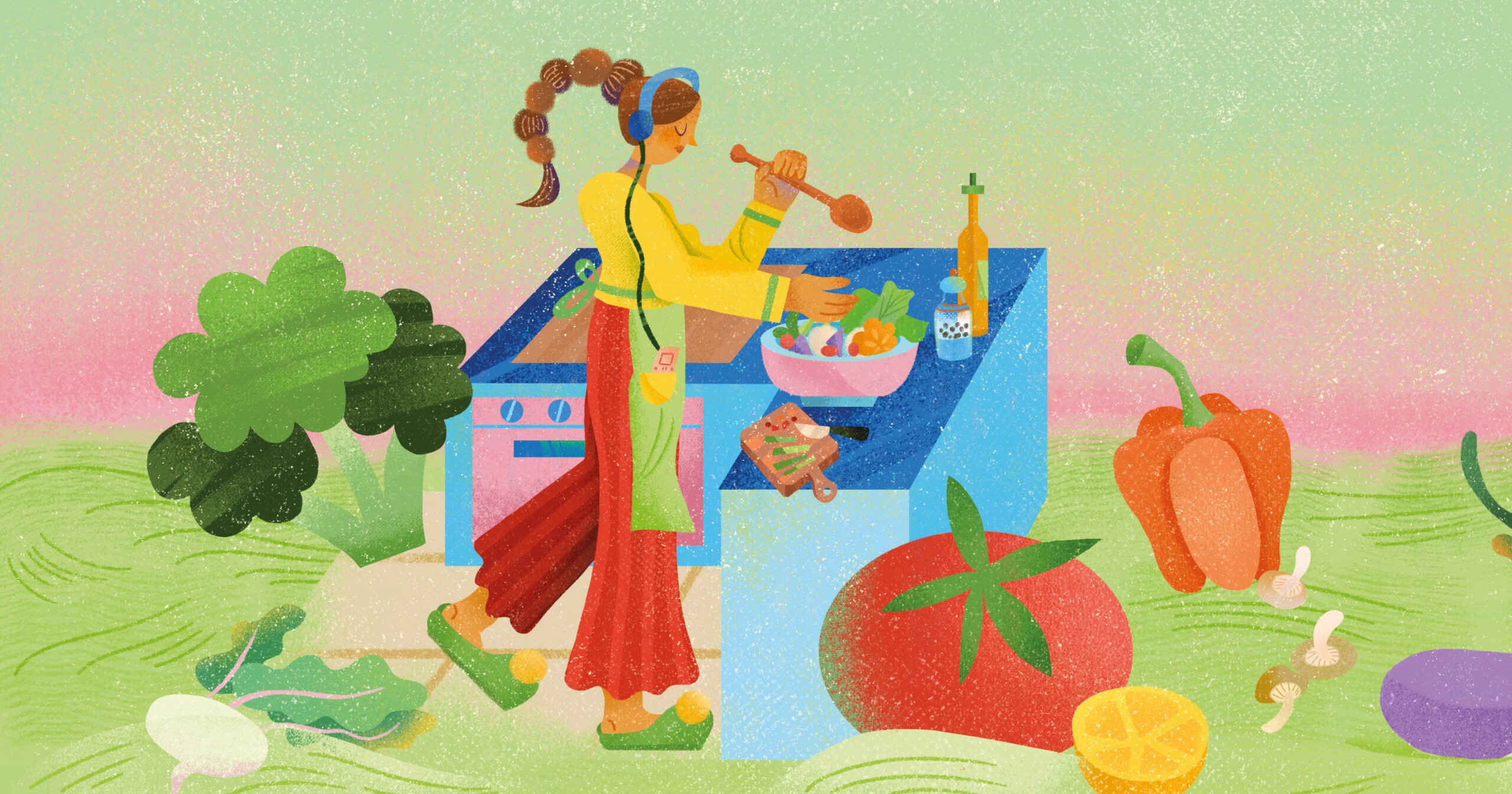
- To help you reframe household tasks. Chores can seem less onerous if you see them as time to enjoy your current audiobook or podcast.