
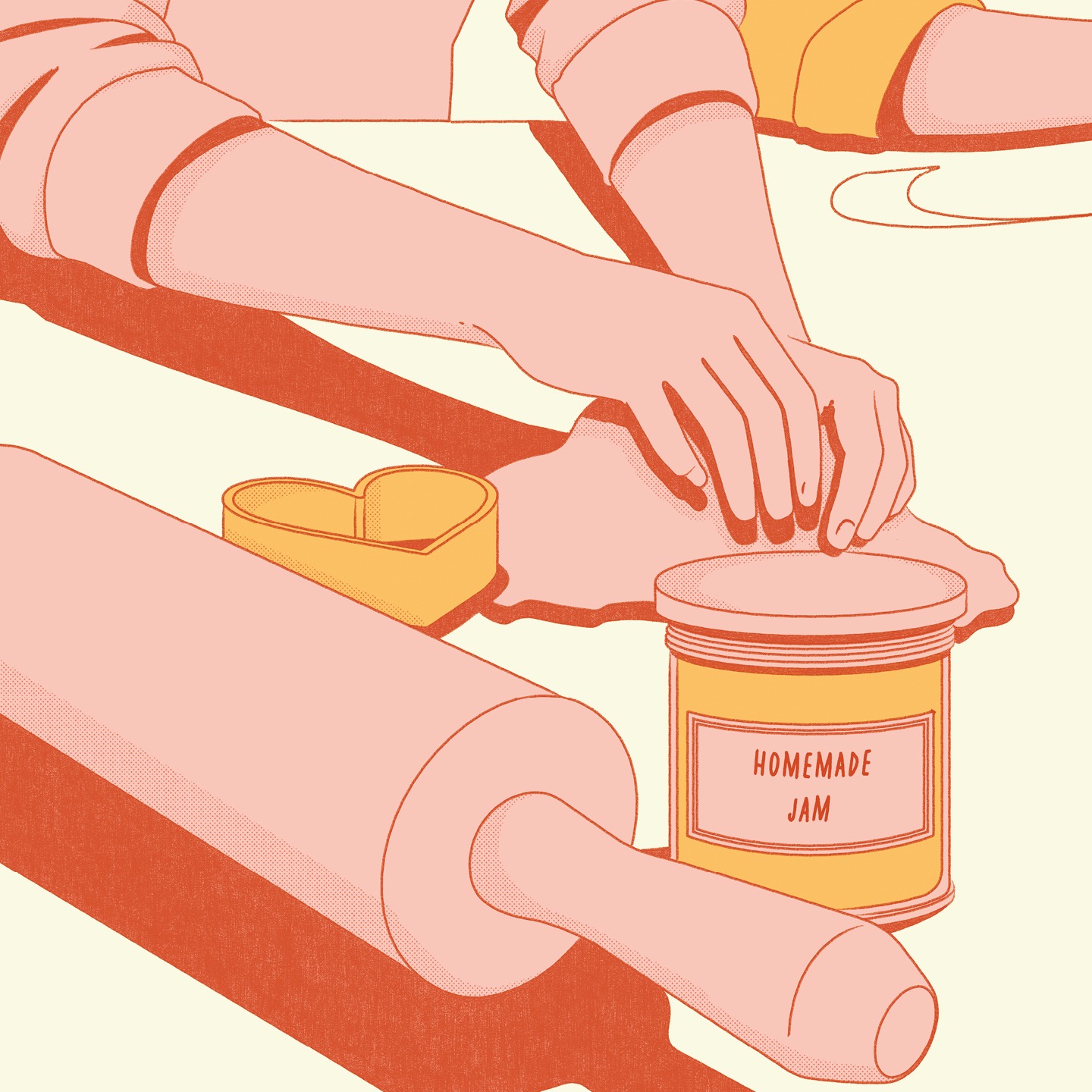
Angela Zaher started cooking with her two sons after their school encouraged parents to involve children in the kitchen. ‘They instructed us how useful it would be for them academically: learning about fractions through cutting up apples in segments, weighing ingredients on scales…’ Angela says. ‘The plan worked beautifully, but what was really striking was all the learning that went on beyond the academics – for them, and for me. The kitchen was where we strengthened our bond. We learnt about each other by working for a common purpose, like a just-out-of-the-oven cookie.’
As food writer Angela and her sons soon discovered, the kitchen can be a surprisingly good place to deepen any relationship – at any age.
Kitchen confidential
Cooking with others opens up a natural space for discussions. As one person peels veg and another stirs the pot, each absorbed in their individual tasks, conversation flows. Because you’re concentrating on something, it takes the pressure off the conversation – which may allow for more reflective or sensitive topics to surface naturally, without the potential awkwardness of a ‘deep and meaningful’ chat. Angela has seen this in action: ‘As my boys grew up, navigating tricky conversations was much easier as we stood side by side, our hands busy with chopping or stirring, leaving our minds free to reflect on what’s troubling them.’
Arguably, you could say the same thing about other shared activities, but perhaps cooking is particularly powerful? Dr Andrea Oskis is a psychologist, food writer and author of The Kitchen Shrink. She says, ‘Cooking is a great way to build connections because, as humans, this is how we start off in life; we are first fed in the context of a caregiving relationship. So unconsciously, there are associations between food and relationships, love and loss.’
Andrea continues, ‘Findings from research show that if we feel happy and secure in our close relationships, and if we trust our loved ones (what researchers call securely attached), then we are more likely to share food, the table and the kitchen.’ So, the very act of cooking together can be an expression of love and security – regardless of what you talk about. In other words, the conversation doesn’t have to be deep to be meaningful.
Baked bonds
In her food writing, Angela focuses on emotional connections to food. This was ever-present when cooking with her young sons, but could equally apply to any relationship.
‘The kitchen was where I started telling them stories from my childhood and my Lebanese and Palestinian heritage,’ she says. ‘It felt natural to do this while we made the dishes that were the staples of my childhood.’
Angela recalls her own mother making date-filled semolina cookies (maamoul) with friends at home in Beirut. ‘She needed many kilos of these cookies over the Easter period – to offer to anyone who dropped by and to take as gifts to friends and relatives. But each cookie has to be made individually; they are a labour of love. So my mother grouped her friends and, together, they’d spend a week going to a different home every day, setting up a production line. The work would be done with much mirth and gossip. I would often feign illness to be allowed to stay at home and watch. And maybe even take part.’
Years later, Angela would make the same cookies at home with her children. ‘As we shaped and rolled the dough on our dining room table in London, I told them how my mother used to make them. The tiny hands of my boys as they rolled and shaped these cookies connected them to their teta and her friends. A single thread that weaved in our past, present and future, and brought us all closer together.’
Shoulder to shoulder
Clearly, the link between food, memory and relationships plays a big role here. So, too, does the relative lack of eye contact in these conversations. Just as Angela found with her boys, side-by-side conversations can sometimes be more open than face-to-face.
Psychologists have long noted that conversations flow better when people walk alongside each other. One reason is that it can be more relaxing – there’s less pressure to maintain eye contact or think about facial expression. Another is that rhythmic movement, such as chopping, stirring or grating, can have a calming effect on the nervous system, making people feel safer to speak openly.
Studies have also shown that men are more likely to define emotional closeness through side-by-side activities, rather than face-to-face conversations. Cooking creates space for this.
Andrea agrees that gaze is a key reason why side-by-side conversations can feel less threatening. ‘Sometimes being face-to-face, and therefore under the gaze of another, can feel like a demand for recognition by that person,’ she says. ‘Now, of course, all of this is going on unconsciously, but there is something that can feel burdensome about it – like we must deliver to the needs of that other person. Side-by-side allows a sharing of the space, without an encroaching of space, and it’s the sense of freedom that comes with that which allows for conversation, and thus connection, to arise.’
Universal language
Some organisations even use cooking together as a way to support communities and strengthen social bonds. One example comes from Cranbrook Community Food Garden in London, where locals grow food and share the resulting crops. It was only a matter of time before this extended to cooking together.
As Lizzy Mace, chair of Cranbrook Community Food Garden, says, ‘When one of our members suggested making a cookbook, the natural way for us to do this was by bringing people together in community cooking sessions to share favourite ways to cook the food we grow, eat together and capture the recipes along the way.’ And so, in 2023 the Globe Town Community Cooking Club was born – resulting in The Cranbrook Community Cookbook two years later.
‘Focusing each session on a few seasonal ingredients from the garden, we’d begin with participants sharing their favourite ways to cook them at home or from their childhood,’ Lizzy says. ‘Together, we’d decide what to cook, resulting in what [cooking club member] Cicely called a “delicious, surprise feast”. People loved discovering diverse ways to prepare vegetables, especially learning about each other’s cultures and traditions. Everyone reported a stronger sense of belonging in the community. Shuma, for example, noted that “food really does bring people together, in so many ways” and Robert agreed it is “an excellent way to share love, foster community and learn about different cultures.”’
By working together to transform seasonal harvests into diverse feasts, the Globe Town Community Cooking Club empowered people to share traditions and cultivate a deep sense of belonging through food.
Feeding wellbeing
Another obvious benefit is that cooking together paves the way for people to eat together. Sharing meals has been shown to have a significant impact on wellbeing. The 2025 World Happiness Report studied the link between wellbeing and eating together and concluded that, ‘Sharing meals proves to be an exceptionally strong indicator of subjective wellbeing – on par with income and unemployment. Those who share more meals with others report significantly higher levels of life satisfaction and positive affect, and lower levels of negative affect. This is true across ages, genders, countries, cultures and regions.’
Cooking in company is not only a fantastic way to learn new things about each other, enjoy quality time and invite deeper conversations – it’s good for your wellbeing too. How’s that for nourishing?
Get cooking
Planning a cooking session with a friend or family member? Here are a few pointers:
- Think about what kind of cooking will work best. Meze, for example, is perfect if you want to cook together but each make your own dishes. Food from another culture provides a joint learning experience. And a dish that recreates a fond memory is good for bonding.
- Recognise that cooking can involve some uncertainty. Andrea says, ‘For those who like structure and control, anything that potentially has a “What do I do next?” element can generate stress and anxiety.’ Cooking from a recipe with clear instructions can help.
- Play background music. It can take the pressure off quiet moments and add a sense of playful fun.
- Worried about conversation drying up? Andrea says, ‘If you want people to talk, give them something to talk about! Relationship-specific hooks are great to hang conversations on without making it feel forced.’ You could, for example, ask about relationships in the past. Alternatively, food questions – such as, ‘Which food feels like your safe haven?’ – can be useful.
- Don’t overthink it. Andrea recommends that you ‘say whatever comes to mind, without censoring’.
- Remember, it’s about the experience, not the end result. Try not to judge other people’s cooking skills, or the meal itself. ‘For some people cooking can be quite hard,’ says Andrea. ‘Taking the judgment out as much as possible is important, as is doing your best to think about cooking as a form of play. It’s about fun, discovery and being good enough.’
Claire Ruston is a British writer living in rural Bulgaria who blogs about growing veg and cooking it at auntiebulgaria.substack.com